Computer vision has quietly become one of the most practical branches of artificial intelligence in enterprise settings.
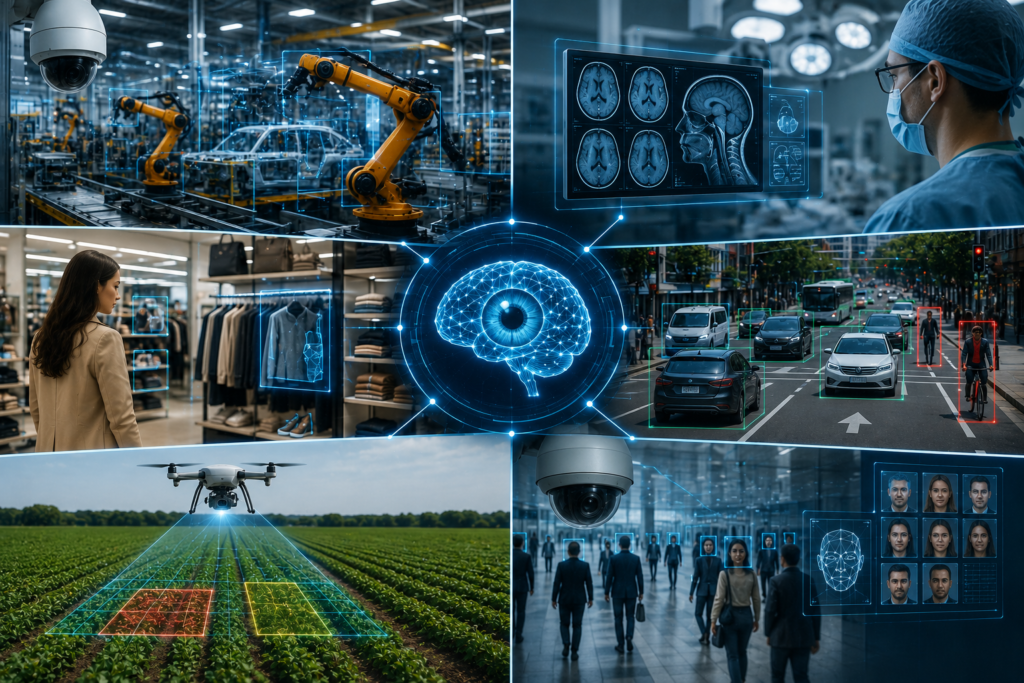
While generative AI captures headlines, computer vision is already embedded in factory floors, hospital radiology departments, retail checkout lines, and warehouse loading docks, doing work that used to require constant human attention.
It teaches machines to interpret images and video the way humans do, then act on that interpretation faster and more consistently than a person could over an eight hour shift.
For enterprise leaders evaluating where to invest AI budgets next, computer vision often delivers a clearer, faster return than more experimental AI applications. It solves visible, measurable problems: missed defects, inventory errors, safety incidents, diagnostic delays. This guide walks through what computer vision actually does, how different industries are using it right now, and what it takes to implement it well.
What Is Computer Vision AI
Computer vision is a field of artificial intelligence that trains machines to extract meaningful information from images, video streams, and other visual inputs.
It combines image processing, deep learning, and pattern recognition so a system can detect objects, classify scenes, track movement, and flag anomalies without a human reviewing every frame.
Modern computer vision systems rely heavily on convolutional neural networks and, increasingly, transformer based vision models. These models learn from large labeled datasets, recognizing patterns like edges, shapes, textures, and motion, then combining those patterns into higher level judgments such as identifying a defective weld or recognizing a specific product on a shelf.
The technology has matured well beyond basic image tagging. Enterprise grade computer vision today handles real time video analytics, 3D spatial mapping, multi camera tracking, and edge deployment on low power devices, which is what makes it viable for factories, retail stores, and hospitals rather than just research labs.
Core Capabilities Businesses Rely On
A few capabilities show up again and again across enterprise deployments. Object detection identifies and locates specific items within an image or video frame. Image classification sorts entire images into categories.
Semantic segmentation labels every pixel in an image, which matters for tasks like medical imaging where precise boundaries determine a diagnosis. Optical character recognition extracts text from documents, labels, and signage.
And motion tracking follows objects or people across a video feed, which powers everything from security monitoring to sports analytics.
Understanding these building blocks helps when evaluating vendors or scoping a project, since most industry use cases are really just combinations of these core functions applied to a specific problem.
Why Enterprises Are Investing in Computer Vision Now
Three things changed that pushed computer vision from a niche research topic into a mainstream enterprise tool. Camera hardware got cheaper and higher resolution. Cloud and edge computing made it affordable to process video at scale.
And deep learning models got dramatically more accurate, particularly after 2015 when convolutional neural networks started outperforming traditional computer vision methods on nearly every benchmark.
The result is a technology that now pays for itself quickly in the right context. A manufacturer that catches defects before shipping avoids costly recalls. A retailer that reduces shrinkage through better shelf and checkout monitoring protects margin directly. A hospital that speeds up radiology triage can treat more patients without adding headcount.
Companies exploring this space typically start by working with an AI Development Company that can assess existing infrastructure, camera systems, and data pipelines before recommending where computer vision will have the most immediate impact.
Computer Vision Use Cases in Manufacturing
Manufacturing has been one of the earliest and most enthusiastic adopters of computer vision, largely because the return on investment is so easy to measure.
Automated Quality Inspection
Traditional quality control relies on human inspectors scanning products for scratches, misalignments, or missing components.
Fatigue sets in, attention drifts, and defects slip through. Computer vision systems mounted on production lines can inspect thousands of units per hour with consistent accuracy, flagging anything that deviates from the reference model.
A real world example is in electronics manufacturing, where cameras inspect printed circuit boards for soldering defects at a resolution and speed no human eye can match. Automotive plants use similar systems to check paint finish, panel gaps, and weld quality before a vehicle moves to the next station.
Predictive Maintenance Through Visual Monitoring
Cameras combined with thermal imaging can spot early signs of equipment wear, like unusual vibration patterns, overheating components, or fluid leaks, before a machine actually fails. This shifts maintenance from a fixed schedule to a condition based approach, cutting unplanned downtime and extending equipment life.
Worker Safety Compliance
Vision systems on factory floors can detect whether workers are wearing required protective equipment, monitor restricted zones for unauthorized entry, and alert supervisors to unsafe behavior in real time.
This is one of the more sensitive applications, since it touches on employee monitoring, so enterprises need clear policies on data retention and worker communication alongside the technical rollout.
Computer Vision in Retail and E-commerce
Retail has embraced computer vision to close the gap between physical and digital shopping experiences.
Cashierless Checkout and Shelf Monitoring
Camera arrays paired with sensor fusion allow stores to track what customers pick up and automatically charge them on exit, removing the checkout line entirely.
Even retailers not ready for a full cashierless model use vision systems for shelf monitoring, detecting when products are out of stock or misplaced so staff can restock before a sale is lost.
Customer Behavior Analytics
Anonymized video analytics help retailers understand foot traffic patterns, dwell time in specific aisles, and which displays actually draw attention. This data informs store layout and merchandising decisions in a way that traditional point of sale data never could.
Visual Search
Shoppers increasingly want to search for products by uploading a photo rather than typing a description. Visual search engines built on computer vision match an uploaded image against a product catalog, a feature that has become standard on major e-commerce platforms and is now within reach for mid sized retailers too.
Computer Vision Applications in Healthcare
Healthcare represents one of the highest stakes and highest value applications of computer vision, where accuracy directly affects patient outcomes.
Medical Imaging and Diagnostics
Computer vision models trained on large datasets of X-rays, MRIs, and CT scans can detect tumors, fractures, and other abnormalities, often flagging cases for radiologist review faster than manual screening alone. These tools are not replacing radiologists, they are acting as a second set of eyes that reduces missed findings and speeds up triage for urgent cases.
Surgical Assistance
During minimally invasive procedures, computer vision helps surgeons by enhancing visualization, tracking instruments in real time, and overlaying relevant imaging data directly onto the surgical field. This kind of augmented visual guidance has become a meaningful part of robotic assisted surgery platforms.
Remote Patient Monitoring
Vision based monitoring systems can track patient movement, detect falls in elderly care facilities, and monitor vital signs like breathing rate through non contact camera analysis, extending care capacity without requiring constant physical presence.
Computer Vision in Logistics and Supply Chain
Warehouses and distribution centers generate enormous volumes of visual data every day, from inbound shipments to outbound pallets, making them a natural fit for computer vision.
Automated Inventory Management
Cameras and drones equipped with computer vision can scan warehouse shelves and count inventory automatically, cross checking physical stock against system records without a single manual count. This dramatically reduces the labor cost and error rate associated with traditional cycle counting.
Package Sorting and Damage Detection
Vision systems on conveyor belts read barcodes and shipping labels, sort packages by destination, and simultaneously inspect for damage before a package leaves the facility. This combination of speed and quality control is difficult to replicate with manual processes at the volume major logistics companies operate.
Fleet and Loading Dock Monitoring
Computer vision helps verify that trucks are loaded correctly, monitor dock activity for safety compliance, and even assess vehicle condition during pre trip inspections, reducing disputes and catching issues before they become costly delays.
Computer Vision in Agriculture
Precision agriculture has become one of the more surprising growth areas for computer vision, driven by drone and satellite imagery combined with ground level sensors.
Crop Health Monitoring
Multispectral cameras mounted on drones can detect early signs of disease, nutrient deficiency, or water stress across large fields, well before symptoms would be visible to a farmer walking the rows. This allows targeted intervention instead of blanket pesticide or fertilizer application, cutting costs and reducing environmental impact.
Automated Harvesting
Vision guided robotic harvesters can identify ripe produce, assess quality, and pick fruit or vegetables with a level of selectivity that mechanical harvesting alone cannot achieve, which matters most for delicate crops where bruising or overripening reduces market value.
Computer Vision in Security and Public Safety
Security has long used cameras, but computer vision changes what those cameras can actually do beyond passive recording.
Real Time Threat Detection
Modern surveillance systems use computer vision to detect unusual behavior, unattended objects, or unauthorized access in real time, alerting security teams instead of relying on someone watching a bank of monitors continuously.
Facial Recognition and Access Control
Facial recognition powers secure access control in corporate buildings and sensitive facilities. This is also one of the more heavily regulated applications of computer vision, and enterprises deploying it need to navigate a patchwork of regional privacy laws carefully.
Key Benefits of Computer Vision for Enterprises
Across every industry mentioned above, a few benefits show up consistently. Computer vision reduces manual labor on repetitive visual inspection tasks, freeing employees for higher value work. It improves accuracy and consistency, since machines do not get tired or distracted the way people do.
It enables real time decision making instead of waiting for periodic manual reviews. And it generates rich visual data that can be analyzed for trends, informing decisions well beyond the original use case.
There is also a compounding effect worth mentioning. Once a company builds the infrastructure for one computer vision use case, whether that is camera networks, edge computing hardware, or a labeled dataset, extending the technology to a second or third use case becomes considerably cheaper and faster.
Challenges in Implementing Computer Vision
None of this comes without friction. Building an accurate model requires large volumes of labeled training data, which can be expensive and time consuming to collect, particularly for niche use cases without existing public datasets.
Models trained on one environment, one lighting condition, or one camera angle often need retraining before they perform reliably elsewhere, and enterprises sometimes underestimate this step.
Integration with existing infrastructure is another common obstacle, since legacy camera systems and industrial equipment were rarely designed with AI in mind. And privacy regulation is becoming a bigger factor with every deployment, especially for use cases involving facial recognition or employee monitoring, where compliance requirements vary significantly across regions.
Working with an experienced Computer Vision Software Development Company helps enterprises avoid the most common pitfalls, from underestimating data requirements to choosing model architectures that do not scale well once deployed across multiple sites.
Getting Started With Computer Vision Adoption
The enterprises that succeed with computer vision tend to start narrow. Rather than attempting a company wide rollout, they pick one high value, well defined problem, such as defect detection on a single production line or inventory counting in one warehouse, prove the value, and then expand from there.
This phased approach also gives teams time to build internal expertise, establish data governance practices, and understand where the technology genuinely adds value versus where a simpler rule based system would do the job just as well.
For enterprises still mapping out where computer vision fits into their broader AI strategy, partnering with an AI Consulting Services provider early on can help prioritize use cases based on actual business impact rather than technical novelty.
Final Thoughts
Computer vision has moved past the experimental phase in nearly every major industry. Manufacturers use it to catch defects before they become recalls, hospitals use it to speed up diagnosis, retailers use it to close the loop between inventory and sales, and logistics companies use it to keep packages moving accurately at scale.
The common thread across all these applications is that computer vision turns visual information, something enterprises have always had but rarely used systematically, into a measurable operational advantage.
The technology will keep expanding into new corners of enterprise operations as models get more accurate and hardware gets cheaper. Businesses that start building visual AI capabilities now, even with a single focused use case, will be far better positioned to scale as new applications emerge.