sheet metal fabrication
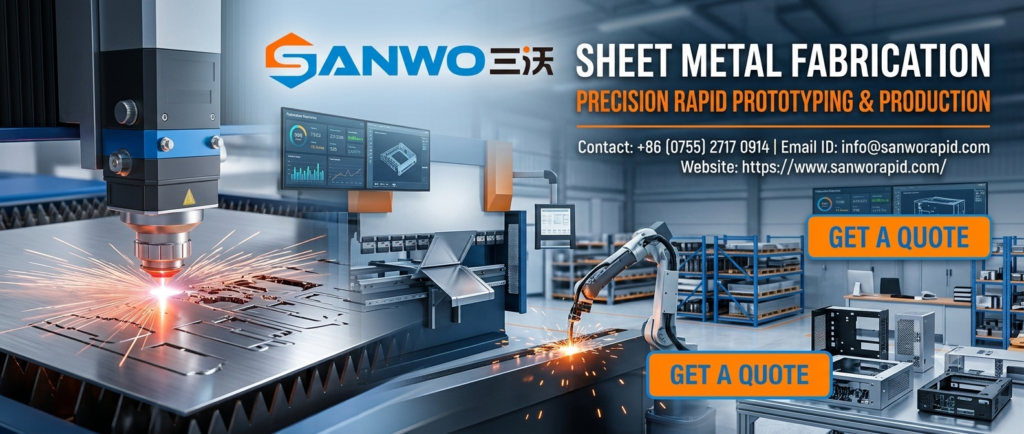
Modern manufacturing depends on sheet metal fabrication to create strong, lightweight, and highly accurate components used across industries. From automotive parts and medical equipment to electronics enclosures and aerospace assemblies, fabricated sheet metal delivers exceptional durability and design flexibility. At Sanwo Rapid, advanced fabrication processes help businesses transform engineering concepts into production-ready parts with speed, consistency, and precision.
What Is Sheet Metal Fabrication?
Sheet metal fabrication is the process of converting flat metal sheets into finished products through cutting, bending, punching, welding, and surface finishing. Materials such as stainless steel, aluminum, brass, copper, and carbon steel are selected based on the product’s strength, corrosion resistance, weight, and application requirements.
Unlike traditional manufacturing methods, sheet metal fabrication enables manufacturers to produce complex geometries with tight tolerances while minimizing material waste.
Common Sheet Metal Fabrication Processes
| Process | Purpose | Typical Applications |
| Laser Cutting | Produces precise cuts with minimal waste | Electronic enclosures, brackets |
| CNC Punching | Creates holes and custom patterns | Control panels, ventilation parts |
| CNC Bending | Forms accurate angles and shapes | Cabinets, frames, chassis |
| Welding | Joins multiple metal components | Industrial equipment, machinery |
| Surface Finishing | Improves appearance and corrosion resistance | Consumer products, medical devices |
Each process contributes to the final product’s performance, quality, and longevity.
Why Sheet Metal Fabrication Matters
Manufacturers choose sheet metal fabrication because it offers an ideal balance between precision, scalability, and cost-efficiency. Modern CNC equipment ensures repeatable accuracy, while automated production reduces lead times and labor costs.
For example, a startup developing an industrial control enclosure can use laser cutting and CNC bending to produce functional prototypes within days. After design validation, the same manufacturing process can seamlessly transition to volume production without significant tooling changes.
This flexibility shortens product development cycles and accelerates market entry.
Industries That Depend on Sheet Metal Fabrication
High-quality fabricated metal components are essential in numerous industries, including:
- Automotive
- Aerospace
- Medical devices
- Consumer electronics
- Telecommunications
- Renewable energy
- Industrial automation
Each sector requires strict dimensional accuracy, reliable material performance, and consistent manufacturing standards.
How Sanwo Rapid Delivers Manufacturing Excellence
At Sanwo Rapid, sheet metal fabrication combines advanced CNC technology with experienced engineering support to deliver precision parts for prototype and production projects. Every project is reviewed for manufacturability, helping customers optimize designs before production begins.
From rapid prototyping to low- and high-volume manufacturing, the company focuses on:
- Tight dimensional tolerances
- Fast production turnaround
- High-quality material selection
- Consistent quality inspection
- Custom fabrication solutions
This approach helps businesses reduce development risks while maintaining superior product quality.
Practical Tips for Better Sheet Metal Design
To improve manufacturing efficiency and reduce costs:
- Select the appropriate material based on strength and environmental conditions.
- Maintain consistent bend radii to minimize forming defects.
- Design with standard sheet thicknesses whenever possible.
- Avoid unnecessary complex features that increase machining time.
- Collaborate with fabrication engineers early in the design stage.
These practices improve manufacturability while reducing production expenses.
Frequently Asked Questions
What materials are commonly used in sheet metal fabrication?
Aluminum, stainless steel, carbon steel, copper, and brass are among the most widely used materials because each offers unique mechanical and corrosion-resistant properties.
Is sheet metal fabrication suitable for prototypes?
Yes. CNC-based fabrication is ideal for rapid prototypes because it provides accurate parts without expensive tooling.
How accurate is modern sheet metal fabrication?
Advanced CNC laser cutting and bending systems can achieve extremely tight tolerances, making them suitable for demanding industrial applications.
Can fabricated parts receive surface treatments?
Absolutely. Powder coating, anodizing, polishing, plating, and painting improve appearance, corrosion resistance, and durability.
Conclusion
As manufacturing continues to demand greater precision, speed, and flexibility, sheet metal fabrication remains one of the industry’s most valuable production methods. By combining advanced equipment, engineering expertise, and strict quality control, Sanwo Rapid helps businesses manufacture reliable components that meet demanding performance standards while reducing development time and production costs.
Contact – +86 (0755) 2717 0914
Email ID – info@sanworapid.com
Website – https://www.sanworapid.com/