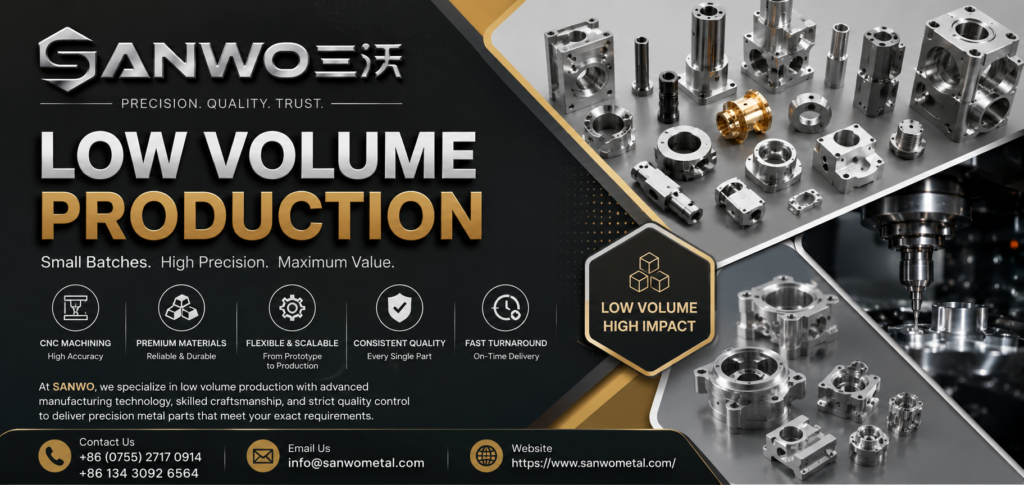
low volume production
In today’s competitive manufacturing environment, companies are under constant pressure to launch products faster, reduce development costs, and respond quickly to changing customer demands. This is why low volume production has become one of the most valuable manufacturing strategies across industries.
Instead of investing heavily in mass production from the beginning, businesses now prefer producing smaller batches that allow them to validate designs, test market demand, and improve product quality before scaling.
Manufacturers like Sanwo Metal help businesses achieve this flexibility by delivering precision-machined components that support rapid product development without the risks associated with large production runs.
What Is Low Volume Production?
Low volume production refers to manufacturing a limited quantity of products, typically ranging from a few dozen to several thousand units. The exact quantity depends on the industry and the complexity of the product.
Unlike traditional mass manufacturing, this approach focuses on flexibility, faster turnaround times, and minimizing financial risk.
It is widely used for:
- Product prototypes
- Pilot production
- Custom industrial equipment
- Medical devices
- Automotive components
- Aerospace parts
- Consumer electronics
- Robotics and automation
This manufacturing model allows businesses to make improvements before committing to high-volume production.
Why Low Volume Production Is Becoming More Important
Global supply chains have changed dramatically over the past few years. Companies now prioritize agility over quantity.
Instead of producing 100,000 parts immediately, many manufacturers begin with 200 or 2,000 units. This strategy helps identify potential issues early while reducing inventory costs.
Current manufacturing trends also emphasize:
- Faster product launches
- Higher customization
- Digital manufacturing
- Sustainable production
- Shorter development cycles
These trends have made low volume production a preferred solution for modern businesses.
Key Benefits of Low Volume Production
Faster Time to Market
Launching products quickly creates a competitive advantage.
Manufacturing smaller batches allows engineering teams to validate designs without waiting months for large production runs.
For example, an electric vehicle startup may manufacture 300 battery housing components first. Engineers can evaluate performance, make improvements, and then move into mass production confidently.
Lower Financial Risk
Large production runs require significant investments in tooling, inventory, and storage.
With low volume production, companies invest only in what they currently need.
This reduces:
- Inventory costs
- Warehouse expenses
- Obsolete stock
- Capital investment
Small production runs also provide flexibility when customer demand changes.
Better Product Quality
Producing fewer parts allows manufacturers to inspect every stage of production more carefully.
Quality engineers can identify machining issues early before they become expensive problems.
This results in:
- Better dimensional accuracy
- Improved surface finish
- Higher consistency
- Fewer rejected parts
Greater Design Flexibility
Product development rarely ends after the first prototype.
Design improvements often continue throughout the early production stages.
Because low volume production uses flexible manufacturing methods such as CNC machining, design revisions can be implemented quickly without rebuilding expensive tooling.
Comparison: Low Volume Production vs. Mass Production
| Feature | Low Volume Production | Mass Production |
| Production Quantity | Small batches | Very large batches |
| Initial Investment | Lower | Higher |
| Design Changes | Easy to implement | Expensive and time-consuming |
| Time to Market | Faster | Longer preparation time |
| Inventory Risk | Low | High |
| Product Customization | Excellent | Limited |
| Best For | New products, prototypes, custom parts | Mature, high-demand products |
Industries That Benefit Most
Many industries rely on low volume production because precision and flexibility are more valuable than quantity.
Examples include:
- Aerospace manufacturing
- Medical equipment
- Automotive development
- Defense applications
- Industrial automation
- Electronics
- Renewable energy
- Robotics
Each industry often requires continuous engineering improvements before entering large-scale manufacturing.
Practical Example
Imagine a medical equipment company developing a new surgical instrument.
Instead of manufacturing 20,000 units immediately, they begin with 500 units.
After hospitals test the product, doctors recommend improving the handle design.
Because the company chose low volume production, the design can be updated without wasting thousands of finished products.
The result is a better product with significantly lower development costs.
How CNC Machining Supports Low Volume Production
CNC machining has become one of the most effective technologies for small production runs.
Unlike traditional manufacturing methods, CNC machines require minimal dedicated tooling.
Advantages include:
- High precision
- Tight tolerances
- Excellent repeatability
- Fast setup
- Material flexibility
- Consistent quality
Manufacturers like Sanwo Metal use advanced CNC machining to produce precision components for customers requiring both prototype and low-volume manufacturing.
Choosing the Right Manufacturing Partner
Selecting the right supplier directly impacts product quality and project timelines.
Look for manufacturers that provide:
- Advanced CNC machining capabilities
- Engineering support
- Material expertise
- Strict quality inspection
- Fast lead times
- Transparent communication
- Experience across multiple industries
An experienced partner can recommend manufacturing improvements that reduce both cost and production time.
Actionable Tips Before Starting Low Volume Production
To maximize the success of your project:
- Finalize critical design requirements before machining begins.
- Choose materials based on actual product performance instead of cost alone.
- Request Design for Manufacturability (DFM) feedback.
- Verify tolerances only where necessary to avoid unnecessary machining costs.
- Test products under real operating conditions before scaling production.
- Work with an experienced manufacturing company such as Sanwo Metal to improve production efficiency.
These steps help reduce delays and improve product reliability.
Why Manufacturers Trust Sanwo Metal
Sanwo Metal combines precision CNC machining with extensive manufacturing expertise to support businesses during every stage of product development.
From engineering prototypes to production-ready components, the company focuses on delivering:
- Precision machining
- Reliable quality
- Fast turnaround
- Competitive pricing
- Custom manufacturing solutions
Its commitment to quality and continuous improvement makes it a trusted manufacturing partner for customers worldwide.
Frequently Asked Questions
What is low volume production?
Low volume production is the manufacturing of small quantities of products before moving to full-scale production. It helps reduce costs, improve product quality, and accelerate product development.
What industries commonly use low volume production?
Industries such as aerospace, automotive, medical devices, robotics, electronics, and industrial automation frequently rely on low volume production because they require flexibility and precision.
Is low volume production more cost-effective?
For new products and customized components, yes. It minimizes inventory, lowers financial risk, and allows design improvements before investing in mass production.
What manufacturing process is best for low volume production?
CNC machining is one of the most effective methods because it offers high precision, rapid production, minimal tooling investment, and excellent repeatability.
Why choose Sanwo Metal for low volume production?
Sanwo Metal offers advanced CNC machining, experienced engineering support, strict quality control, and fast delivery, making it an ideal manufacturing partner for prototype and low-volume manufacturing projects.
Final Thoughts
Modern manufacturing is no longer defined by producing the highest number of parts—it is defined by producing the right parts at the right time with the highest possible quality. Low volume production enables companies to innovate faster, reduce financial risk, and bring better products to market.
By partnering with an experienced manufacturer like Sanwo Metal, businesses gain access to precision machining expertise, flexible production capabilities, and dependable quality that support long-term success in an increasingly competitive global market.
Contact – +86 (0755) 2717 0914; +86 134 3092 6564
Email ID – info@sanwometal.com
Official Website – https://www.sanwometal.com/