In today’s highly competitive manufacturing environment, companies are always looking for ways to improve efficiency, reduce waste and ensure product quality. Traditional, manual inspection methods are ill-suited to meet the demands of modern production and lead to errors, delays and higher costs. This is where industrial machine vision technology has become a game changer.
Today’s vision systems for manufacturing use state-of-the-art cameras, artificial intelligence (AI), image processing software and automation to inspect products, monitor production lines and make real-time decisions. They improve accuracy, increase production speed and minimize manual inspection requirements, enabling manufacturers to achieve higher productivity with the same exceptional quality standards.
This article explores how industrial machine vision contributes to productivity and why more manufacturers are adopting this technology to remain competitive.
Understanding Industrial Machine Vision
Industrial machine vision is the term used for computer-based imaging systems that automatically inspect, identify, measure and analyze products during the manufacturing process.
Traditional cameras simply capture images for people to view. Machine vision systems capture images that are analyzed by special software and artificial intelligence algorithms to make decisions in real-time.
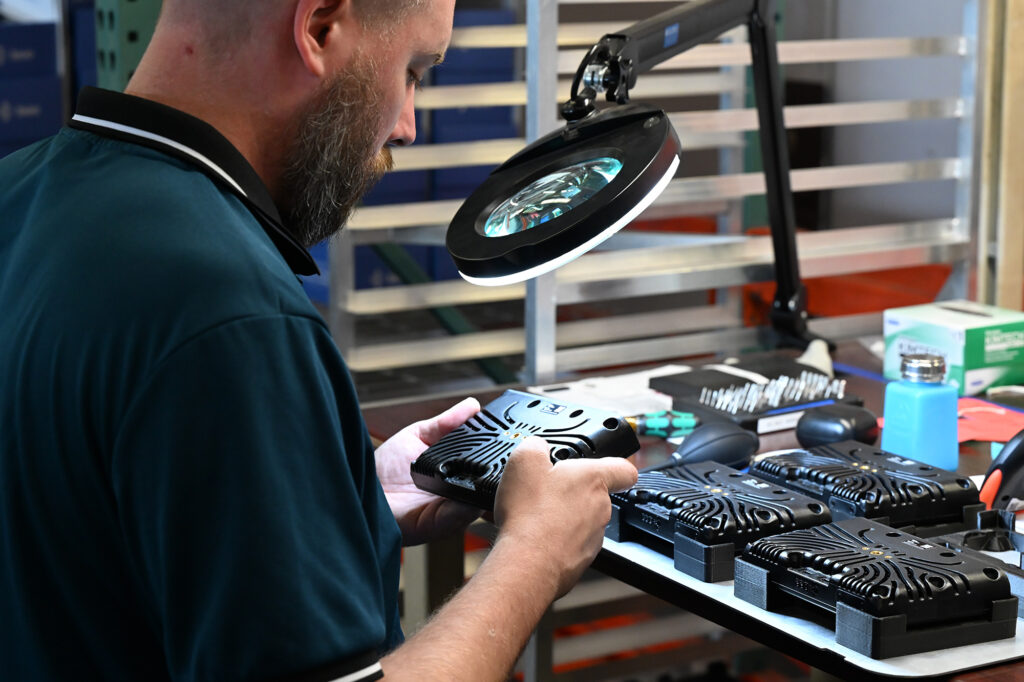
These systems typically consist of high-resolution industrial cameras, lighting systems, lenses, image processing software and computing hardware that work in conjunction to identify defects, verify product quality and guide automated equipment.
Instead of repetitive visual inspection, manufacturers can use automated analysis to achieve faster and more consistent results.
Improves Product Quality
One of the greatest advantages of machine vision is its ability to improve product quality.
Human inspectors may become fatigued during long shifts, increasing the likelihood of missed defects or inconsistent inspections.
Machine vision systems inspect every product with the same level of precision regardless of production volume or operating hours.
They can detect scratches, cracks, missing components, dimensional errors, color inconsistencies, labeling mistakes, and assembly defects that may be difficult for the human eye to identify.
Consistent quality inspections lead to fewer defective products reaching customers while strengthening brand reputation.
Increases Production Speed
Speed is essential in modern manufacturing.
Manual inspections often slow production because operators need time to visually examine each product.
Automated vision systems for manufacturing inspect products almost instantly without interrupting production flow.
High-speed image processing enables thousands of inspections every hour while maintaining remarkable accuracy.
This increased inspection speed allows manufacturers to raise production output without sacrificing quality.
Faster production cycles also improve customer satisfaction by reducing lead times.
Reduces Human Error
Even experienced inspectors sometimes make mistakes because they are tired, distracted or have a different sense of judgement.
Many of these challenges are overcome by machine vision, where the same inspection criteria are applied to each product.
Algorithms measure very accurately, and don’t lose focus after working for a long time.
Fewer inspection errors means fewer product recalls, warranty claims, and customer complaints; it also means improved overall production reliability.
machine vision maintains consistency to enable continuous quality improvement throughout manufacturing operations.
Minimizes Waste and Scrap
Defective products consume valuable materials, labor, and production time.
When defects are detected late in the manufacturing process, the resulting scrap can become extremely expensive.
Machine vision identifies problems immediately, allowing manufacturers to correct production issues before large quantities of defective products are produced.
Early defect detection reduces material waste, lowers manufacturing costs, and improves overall production efficiency.
Minimizing scrap also supports sustainability initiatives by reducing unnecessary resource consumption.
Enhances Process Control
Machine vision systems provide continuous monitoring throughout the production process.
Instead of inspecting only finished products, manufacturers can monitor individual production stages in real time.
The system immediately identifies deviations such as incorrect part placement, alignment issues, or assembly errors.
Operators receive instant feedback, allowing them to correct problems before production quality is affected.
Improved process control results in more stable manufacturing operations and higher productivity.
Supports Automation
Automation has become a key driver of manufacturing productivity.
Machine vision acts as the “eyes” of automated equipment by providing accurate visual information for robotic systems.
Vision-guided robots can identify product locations, measure dimensions, verify orientation, and perform highly precise assembly operations.
This combination of robotics and machine vision reduces manual handling while increasing production speed and accuracy.
Automated manufacturing systems also operate continuously with minimal downtime.
Improves Worker Safety
Some manufacturing environments expose workers to hazardous conditions such as extreme temperatures, moving machinery, chemicals, or heavy equipment.
Machine vision reduces the need for employees to perform repetitive inspections in dangerous areas.
Automated inspection systems monitor production safely while workers focus on supervision, maintenance, and higher-value responsibilities.
Improving workplace safety also helps reduce injuries and improve employee satisfaction.
Provides Real-Time Data
One of the most valuable benefits of industrial machine vision is access to production data.
Modern systems continuously collect information about inspection results, defect rates, production speeds, equipment performance, and process stability.
Manufacturers can analyze this data to identify recurring issues, optimize workflows, and improve overall operational efficiency.
Real-time dashboards also allow managers to make faster, data-driven decisions that improve productivity.
The availability of detailed production analytics supports continuous process improvement.
Reduces Operating Costs
Although machine vision requires an initial investment, the long-term financial benefits often outweigh implementation costs.
Automated inspections reduce labor requirements while minimizing waste, rework, product recalls, and warranty expenses.
Improved production efficiency also lowers energy consumption and equipment downtime.
Over time, manufacturers typically achieve significant cost savings through higher productivity and reduced operational inefficiencies.
Machine vision often delivers an excellent return on investment.
Increases Production Flexibility
Today’s manufacturers frequently produce multiple product variations on the same production line.
Machine vision systems can quickly switch inspection parameters when production changes occur.
Software updates allow manufacturers to inspect new products without replacing hardware or redesigning inspection equipment.
This flexibility supports faster product launches while reducing production interruptions.
Adaptable inspection systems help manufacturers respond quickly to changing customer demands.
Enables Predictive Maintenance
Machine vision contributes to equipment maintenance as well.
Cameras continuously monitor machinery for signs of wear, misalignment, leaks, overheating, or unusual operating conditions.
Early detection allows maintenance teams to repair equipment before unexpected breakdowns occur.
Predictive maintenance minimizes downtime, extends equipment lifespan, and improves production reliability.
Reliable equipment contributes directly to higher manufacturing productivity.
Supports Industry 4.0 Initiatives
Machine vision is an important part of Industry 4.0 and intelligent manufacturing.
Vision technology plays a key role in fully connected production environments by connecting with artificial intelligence, cloud computing, Industrial Internet of Things (IIoT) platforms and manufacturing execution systems (MES).
Inspection data can automatically call for process adjustments, quality alerts, maintenance requests, or production reports.
These intelligent manufacturing ecosystems mean better operational visibility and decision making across the whole facility.
Choosing the Right Vision System
The choice of the right machine vision solution depends on the production requirements.
The manufacturers should take into account the things like inspection speed, image resolution, lighting conditions, product complexity, software capabilities, AI integration, environmental conditions and scalability.
Partnering with experienced technology providers helps ensure the selected solution supports current production goals and future expansion.
Proper integration and training of employees are also key to maximizing long-term performance.
Conclusion
Industrial machine vision has changed modern manufacturing by improving the accuracy of inspection, decreasing waste, and offering intelligent automation that speeds up production. Manufacturing vision systems help companies achieve higher productivity and guarantee superior product quality by enabling real-time quality control, predictive maintenance, robotics integration, and data-driven decision-making.
As manufacturing advances on its path to greater automation and digital transformation, machine vision will continue to be a key technology for improving efficiency, reducing costs, and increasing competitiveness.
If your organization is ready to enhance productivity with advanced machine vision technology, Hellbender offers innovative vision solutions designed specifically for modern manufacturing environments. Their expertise in AI-powered inspection systems helps manufacturers optimize operations, improve quality, and achieve long-term operational success.
Contact Hellbender today to learn how advanced machine vision solutions can transform your manufacturing processes and drive greater productivity.