Key Takeaways
- The UAE gaming market is growing at a 7.69% CAGR (2026–2034), fueled by mobile gaming, esports, and government-backed digital initiatives.
- The Middle East & Africa AR/VR market is projected to reach USD 0.52 billion by 2034, with the UAE leading regional adoption.
- UAE AR/VR headset sales are growing at a staggering 25% CAGR, expected to touch $500 million by 2030.
- Mobile game development costs in the UAE typically range from AED 70,000 to AED 1.8 million, depending on complexity.
- Unity is the preferred engine for most mobile AR/VR games; Unreal Engine wins for AAA, photorealistic experiences.
- Government programs like Dubai Program for Gaming 2033 and Abu Dhabi’s $1 billion esports island are actively pulling global studios into the region.
- Choosing the right AR VR game development company in UAE can be the difference between a shelved MVP and a scalable, revenue-generating product.
- Beyond entertainment, AR/VR is transforming UAE healthcare, education, real estate, and retail training.
If you’ve been watching the UAE’s digital economy over the past year, you already know gaming isn’t a side hobby here anymore — it’s a national priority. Abu Dhabi is building a billion-dollar esports island, Dubai has its own Program for Gaming 2033, and everyday consumers are spending more time (and money) on mobile and immersive gaming than almost anywhere else in the Middle East.
For founders, studios, and enterprises trying to capture this wave, the real question isn’t “should we build a game or AR/VR app?” — it’s “who do we build it with, and what will it actually cost us?” That’s exactly what this guide answers.
We’ll walk through real UAE market data, the technology decisions that actually matter (Unity vs. Unreal, mobile vs. headset-based), realistic budgets, and a practical checklist for picking a partner. If you’re evaluating a mobile gaming app development company for your next project, this is the research you need before you sign anything.
Most founders come into this conversation with one of two problems. Either they’ve seen a competitor launch a slick AR experience and want something similar without knowing what it actually takes to build, or they have a rough idea (a branded mobile game, a VR showroom, a training simulator) but no framework for evaluating vendors, timelines, or realistic costs. This guide is written to solve both problems at once — with market data specific to the UAE, not generic global averages that don’t reflect local costs, regulations, or user behavior.
What Exactly Does “AR/VR Game Development” Mean?
Before diving into costs and vendors, it’s worth clarifying terms — because “AR,” “VR,” and “gaming” often get lumped together when they actually describe distinct technical approaches with different budgets and use cases.
- Augmented Reality (AR) overlays digital elements — characters, information, animations — onto the real world, typically viewed through a smartphone camera. Think location-based mobile games or an AR furniture placement tool.
- Virtual Reality (VR) replaces the real world entirely with a simulated 3D environment, usually experienced through a headset like Meta Quest or HTC Vive.
- Gaming development, in this context, refers to the broader discipline of building interactive digital experiences — which may or may not include AR/VR elements, spanning mobile, PC, console, and cross-platform titles.
A mobile game development company will typically have the deepest expertise in AR since it’s camera- and sensor-based rather than headset-dependent, which is why most consumer AR games in the UAE ship on mobile first, with a headset-native version considered only once the concept is validated.
The UAE Gaming & AR/VR Market in 2026: What the Data Actually Shows
Let’s start with numbers, because that’s what informs a real investment decision.
The UAE gaming market is expanding at a compound annual growth rate of roughly 7.69% through 2034, driven by mobile gaming adoption, esports infrastructure spending, and a young, hyper-connected population. On the immersive technology side, the Middle East & Africa AR/VR market was valued at approximately USD 0.21 billion in 2025 and is expected to climb to USD 0.52 billion by 2034 — and the UAE, alongside Saudi Arabia, is the primary engine behind that growth.
Here’s a snapshot of the numbers worth knowing:
| Metric | Data Point | Timeframe |
| UAE Gaming Market CAGR | 7.69% | 2026–2034 |
| MEA AR/VR Market Size | USD 0.24B → 0.52B | 2026–2034 |
| UAE AR/VR Headset Market | 25% CAGR, reaching $500M | By 2030 |
| Global VR Gaming Market | $38.44B → $259.78B | 2026–2034 |
| Abu Dhabi Esports Investment | $1 billion (Esports Island) | Announced 2024 |
| UAE Share of MENA-3 Gaming Revenue | 33.7% (Saudi Arabia leads at 59.1%) | Current |
What stands out is the sheer speed of AR/VR hardware adoption — a 25% CAGR is not a “wait and see” number, it’s a market that’s actively being built right now. Government-backed gaming zones like Dubai Studio City and the phygital gaming format pioneered at Abu Dhabi’s Games of the Future (13 hybrid disciplines, $10 million prize pool, 40+ countries participating) show this isn’t hype — it’s infrastructure with real money behind it.
It also helps to understand where the UAE sits regionally. Saudi Arabia currently commands close to 59% of MENA-3 gaming revenue, largely on the back of Public Investment Fund spending, while the UAE holds roughly 34%. Rather than competing on scale, the UAE is positioning itself on quality, regulatory sophistication, and innovation — which is exactly why so many international studios are choosing Dubai and Abu Dhabi as their regional base rather than treating the market as a pass-through.
That said, the market isn’t without friction. A full iGaming regulatory framework hasn’t been finalized yet, which keeps some international operators cautious about long-term investment. There’s also a genuine talent shortage — the UAE attracts senior esports athletes and executives easily, but the deep bench of mid-tier developers, 3D artists, and engineers that sustains a mature gaming industry is still being built. For businesses entering the market now, this actually creates an advantage: getting your product live before the competitive landscape becomes saturated.
Any serious game development company in Dubai operating today has to factor these dynamics into project planning — not just the technology, but the regulatory timeline, hiring realities, and the pace at which consumer expectations are shifting.
Quick Question: Is the gaming industry actually big in the UAE, or is it mostly hype? Quick Answer: It’s real — the UAE holds roughly a third of MENA-3 gaming revenue and has committed over a billion dollars to esports infrastructure alone.
Why UAE Businesses Are Investing in AR/VR Gaming Right Now
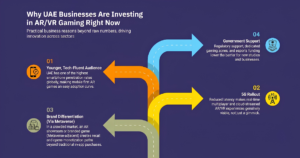
Beyond the raw numbers, there are practical business reasons why founders, real estate firms, retailers, and even hospitals are commissioning gaming and AR/VR builds:
- Younger, tech-fluent audience — UAE has one of the highest smartphone penetration rates globally, making mobile-first AR games an easy adoption curve.
- 5G rollout — Reduced latency is making real-time multiplayer and cloud-streamed AR/VR experiences genuinely viable, not just a demo-day gimmick.
- Government tailwinds — Regulatory support, gaming zones, and esports funding lower the barrier for studios entering the market.
- Brand differentiation — In a crowded retail and real estate market, an AR-powered showroom or a branded mobile game creates recall that a static app simply can’t.
- Metaverse-adjacent demand — Consumers are increasingly comfortable owning virtual assets and identities, which opens monetization paths beyond traditional in-app purchases.
If you’re building a consumer-facing product, partnering with an experienced AR VR app development company early — rather than retrofitting AR features later — tends to save both budget and timeline.
There’s also a competitive-timing argument that’s easy to overlook. The UAE’s digital consumers are notoriously fast adopters — they’ll try a new AR experience or a gamified loyalty app within days of launch, but they’ll also abandon it just as quickly if it feels dated or slow. That means the businesses winning right now aren’t necessarily the ones with the biggest budgets; they’re the ones who shipped early, iterated based on real usage data, and treated their first version as a learning tool rather than a finished product. Waiting for a “perfect” build often means missing the window entirely.
Key Use Cases of Gaming + AR/VR Development Across Industries
Gaming and AR/VR development in the UAE isn’t confined to entertainment apps. Here’s where we’re seeing the strongest commercial traction:
| Industry | AR/VR & Gaming Application |
| Retail & Malls | AR-powered virtual try-ons, gamified loyalty apps, in-store treasure hunts |
| Real Estate | Immersive VR property walkthroughs and virtual staging |
| Tourism & Hospitality | AR city guides, VR previews of hotel experiences |
| Education & Training | Gamified learning modules, VR simulations for technical training |
| Oil & Gas / Manufacturing | VR safety training and equipment simulation |
| iGaming & Entertainment | Mobile casino-style games, esports platforms, VR casino experiences |
| Events & Exhibitions | Phygital competitions blending physical performance with digital gameplay |
The oil & gas and manufacturing sectors, in particular, have quietly become one of the biggest enterprise buyers of VR simulation technology in the region — it’s cheaper and safer to train someone in a virtual refinery than a real one. A single onsite training incident can cost far more than the VR module that could have prevented it, which is why enterprise procurement teams have become comfortable approving these budgets even without the consumer hype that surrounds gaming.
Retail is another sector worth a closer look. Malls across Dubai and Abu Dhabi are experimenting with AR-powered scavenger hunts, gamified loyalty programs, and virtual try-on experiences for fashion and beauty brands — all designed to increase dwell time and repeat visits. These aren’t experimental side-projects anymore; several major retail groups now treat a gamified mobile experience as a standard part of their customer engagement stack, on par with a loyalty app or a CRM integration.
Tourism and hospitality brands are leaning into AR city guides and pre-visit VR previews, letting travelers experience a hotel suite or a desert safari before booking — a tactic that measurably improves conversion rates for high-ticket bookings. And in events and exhibitions, phygital formats (blending physical performance with digital scoring and rewards) are becoming a signature UAE export, actively influencing how similar events are designed in other markets.
Unity vs. Unreal Engine: Which Should You Actually Use?
This is, hands down, the most-asked question we see on developer forums, Reddit threads, and Quora when people start scoping an AR/VR project — and the honest answer is: it depends on what you’re building, not which engine is “better” in the abstract.
Unity is the go-to choice for:
- Mobile AR games and lightweight XR experiences
- Cross-platform builds (Android, iOS, Meta Quest, HoloLens, WebXR)
- Teams that want faster iteration and a larger asset store
- Projects with tighter timelines and budgets
Unreal Engine is the better fit for:
- AAA-quality, photorealistic VR experiences
- Cinematic or architectural walkthroughs
- High-end training simulations (aviation, defense, medical visualization)
- Projects where visual fidelity matters more than development speed
Most consumer mobile games and retail AR experiences in the UAE lean toward Unity because of faster time-to-market and broader device compatibility. Unreal tends to show up in enterprise-grade training simulations and flagship branded VR experiences where budget and timeline are less constrained.
| Factor | Unity | Unreal Engine |
| Learning curve | Beginner-friendly | Steeper, especially for coding |
| Best for | Mobile AR, cross-platform XR | AAA VR, cinematic experiences |
| Licensing | Seat-based subscription | Royalty (5% after $1M revenue) |
| Platform support | Android, iOS, Quest, HoloLens, WebXR | PC, console, high-end headsets |
| Visual fidelity | Good, improving rapidly | Industry-leading (Nanite, Lumen) |
| Development speed | Faster iteration | Slower, more resource-intensive |
| Typical UAE use case | Retail AR, mobile games, training apps | Flagship VR showcases, architectural walkthroughs |
The practical takeaway: don’t pick an engine because it’s trendy or because a competitor used it. Pick it based on your target device, your budget for iteration cycles, and how much visual fidelity your specific use case genuinely requires. A mobile AR loyalty game does not need Unreal’s cinematic rendering pipeline — it needs to load fast and run smoothly on a mid-range smartphone.
Quick Question: Should a startup with a limited budget use Unity or Unreal for their first AR/VR app?
Answer: Almost always Unity — it’s faster to build, cheaper to iterate on, and works across far more devices out of the box.
How Much Does AR/VR Game Development Cost in the UAE?
This is the number everyone actually wants — so let’s be direct about it.
Mobile game development costs in the UAE typically range from AED 70,000 to AED 1.8 million, depending on complexity, platform, and feature scope. Here’s a realistic breakdown:
| Game Type | Estimated Cost (AED) | Typical Timeline |
| Simple Mobile Game (puzzle, arcade) | 73,400 – 220,200 | 3–4 months |
| Mid-Scale Game (multiplayer, social features) | 220,200 – 550,500 | 5–8 months |
| Complex Game (AR/VR integration, console-level quality) | 550,500 – 1,835,000 | 8–12 months |
| Basic VR Experience | ~$3,000 – $10,000 | 2–3 months |
| Mid-Complexity VR Game | $30,000 – $85,000 | 4–7 months |
| AAA-Level VR Game | $50,000 – $100,000+ | 12–24 months |
A few cost drivers worth budgeting for beyond the base development number:
- Testing & QA — typically 10–30% of total budget, especially critical for VR comfort and performance.
- Marketing — industry experts recommend allocating 25–30% of your budget toward launch marketing.
- Licensing — Unity Pro fees or Unreal’s 5% royalty after the first $1 million in revenue.
- Localization — Arabic-language content and cultural customization for UAE audiences adds cost but significantly boosts local engagement.
If you’re specifically exploring the real-money gaming space, costs and regulatory considerations shift quite a bit — our detailed iGaming software development in UAE cost guide breaks that down separately, since licensing and compliance requirements make it a distinct budgeting exercise from standard mobile games.
What Actually Pushes VR Game Development Cost Up or Down
Understanding the true VR game development cost for your specific project means looking past the headline numbers and into the variables that actually move the needle:
- Asset fidelity — Photorealistic 3D models and motion-capture animation can consume 30–50% of a project’s total budget on their own.
- Team composition — In-house senior developers cost more upfront but reduce iteration risk; outsourced staff augmentation offers flexibility at a lower initial spend.
- Feature scope — Multiplayer support, push notifications, social sharing, and multilingual support each add development hours.
- Platform count — Building for mobile AND headset simultaneously roughly doubles QA effort, even if the core codebase is shared.
- Content localization — Arabic-language support and culturally adapted assets add cost but are close to non-negotiable for strong UAE engagement.
There are two practical ways vendors typically estimate cost. The first is a bottom-up breakdown — estimating each development phase (design, engineering, QA, deployment) separately and summing the total. The second is comparative benchmarking — pricing your project against similar, already-shipped titles in the same complexity tier. A credible AR VR game development company in UAE should be able to walk you through both methods, not just hand you a single flat number with no breakdown.
Monetization Models Worth Planning For Early
Cost planning isn’t just about what you spend — it’s about how the app earns its budget back. The most common monetization approaches for UAE gaming and AR/VR apps include:
- In-app purchases — Cosmetic items, power-ups, or virtual currency, especially effective in mobile and metaverse-adjacent titles.
- Subscription models — Recurring access to premium content, increasingly common in fitness- and education-gamification apps.
- Branded sponsorships — Retail and FMCG brands sponsoring in-game assets or AR filters in exchange for visibility.
- Freemium with ad support — Lower barrier to entry, monetized through non-intrusive advertising placements.
- B2B licensing — Enterprise VR training modules sold or licensed to companies rather than individual consumers.
Deciding on a monetization path before development starts changes technical requirements significantly — a subscription model needs backend billing infrastructure that a simple ad-supported game doesn’t, so this decision belongs in the discovery phase, not as an afterthought post-launch.
Step-by-Step: How SISGAIN Builds Your AR/VR Gaming App
Here’s what a structured, low-risk build process actually looks like:
- Discovery & Business Planning — We map your target audience, monetization model, platform choice, competitive landscape, and feature scope before writing a single line of code. This stage alone often prevents the most expensive mistake in gaming: building the wrong feature set for the wrong audience.
- Prototyping — A clickable prototype validates the user journey and game mechanics early, saving significant rework later. This is also the deliverable most founders use to raise funding or get internal stakeholder buy-in before committing to full development.
- Game Design Document (GDD) — This connects your creative vision to the technical architecture and backend requirements, covering everything from core mechanics to progression systems and monetization triggers.
- Engine & Tech Stack Selection — Unity, Unreal, ARKit/ARCore, or a hybrid stack, chosen based on your specific use case, target platforms, and budget — not a default template applied to every project regardless of fit.
- Development Sprints — Agile builds with regular milestone reviews, typically in 2-week sprints, so you’re never surprised at delivery and can course-correct early if priorities shift.
- QA & Performance Testing — Especially critical for VR comfort, frame rate stability, motion sickness mitigation, and cross-device compatibility across a wide range of UAE-popular smartphones and headsets.
- Launch & Post-Launch Support — App store optimization, performance monitoring, and iterative updates based on real user behavior data — because the first release is rarely the final version.
This same process applies whether you’re building a standalone game or need it integrated into a broader digital ecosystem — which is often where working with a full-service mobile app development company in UAE pays off, since your gaming or AR/VR feature usually needs to plug into existing CRM, payment, or loyalty systems.
How to Choose the Right AR/VR Game Development Company in UAE
Not every developer who lists “AR/VR” on their homepage has actually shipped a production-grade immersive product. Use this checklist before signing a contract:
- Portfolio depth — Ask for AR/VR-specific case studies, not just general app development work.
- Engine expertise — Confirm hands-on experience with both Unity and Unreal, not just one.
- UAE market experience — Local regulatory knowledge (especially for iGaming or fintech-adjacent gaming) matters.
- Post-launch support — Immersive apps need ongoing performance tuning; ask what support looks like after launch.
- Transparent cost breakdown — A vendor unwilling to break down design, development, QA, and marketing costs separately is a red flag.
- Cross-platform capability — Can they build for mobile, headsets, and web simultaneously if your roadmap expands?
- Client reviews and ratings — Verified reviews on platforms like Clutch carry more weight than testimonials on a company’s own site.
- Communication cadence — Ask specifically how often you’ll receive builds, demos, or progress reports — vague answers here are a warning sign of poor project management downstream.
- IP ownership clarity — Confirm in writing that you retain full ownership of source code, assets, and any custom tooling built during the engagement.
It’s worth doing at least one paid discovery or prototyping engagement before committing to a full build contract. A short, well-scoped prototype sprint tells you far more about a vendor’s actual capability and communication style than any sales call or portfolio review ever will — and it caps your financial exposure if the fit turns out to be wrong.
Beyond Gaming: How AR/VR Is Reshaping Other UAE Industries
While gaming gets most of the attention, the underlying AR/VR technology is quietly transforming other high-value sectors in the UAE. Real estate is one of the clearest examples — with property prices in Dubai and Abu Dhabi at a premium, developers are using immersive VR walkthroughs to let international buyers tour properties without ever boarding a flight.
This isn’t a gimmick — it’s now a standard expectation from serious buyers and investors. If you’re in the property sector and want to understand exactly how this is being implemented locally, our breakdown on VR real estate tours in Dubai covers real deployment examples and ROI considerations.
Healthcare, education, and enterprise training are following similar patterns — using gamified, immersive experiences not for entertainment, but to reduce training costs, improve retention, and de-risk high-stakes scenarios (like operating heavy machinery or handling emergency procedures) in a virtual environment first.
Education is following a similar trajectory. Universities and corporate training departments across the UAE are replacing static e-learning modules with gamified, scenario-based VR training — largely because retention rates for immersive learning consistently outperform video-based or text-based instruction. The same underlying game engines and design principles used to build a consumer mobile game are directly transferable to building these training environments, which is why studios with strong core gaming expertise are increasingly the ones winning enterprise VR contracts, not traditional e-learning vendors.
Future Trends: What’s Next for Gaming and AR/VR in the UAE (2026–2030)
- Phygital gaming will keep expanding beyond esports into retail, fitness, and events — blending real-world performance with digital rewards.
- AI-powered personalization will become standard in mobile games, adjusting difficulty, content, and monetization prompts per user in real time.
- Cloud gaming will reduce hardware barriers, letting more users access high-fidelity games without expensive devices.
- Metaverse-adjacent commerce — virtual goods, digital identity, and branded virtual spaces will keep growing as consumer comfort with virtual ownership increases. Expect more brands actively working with a metaverse development company UAE teams trust for these builds.
- Regulatory clarity for iGaming — while a full framework isn’t finalized yet, expect clearer licensing structures to emerge, opening the door for more regulated real-money gaming platforms.
- Talent investment — with a current shortage of mid-tier developers and artists, expect more UAE-based studios to invest in local talent pipelines rather than relying solely on international outsourcing.
- Cross-border esports collaboration — following the 2025 Games of the Future, expect deeper integration between UAE events and international tournament circuits, creating more sponsorship and platform opportunities for locally-built games.
- Rising demand for Arabic-first content — as competition increases, generic, translated content will lose ground to titles designed around local culture, humor, and context from the ground up.
Businesses that start building now — while the competitive landscape is still forming — have a real structural advantage over those who wait for the market to mature and then try to catch up against entrenched players.
Why SISGAIN Is the Right AR/VR & Gaming Development Partner in UAE
Building a gaming or AR/VR product isn’t just about writing clean code — it’s about understanding player psychology, UAE market behavior, monetization strategy, and the technical nuance of shipping across mobile, headsets, and web simultaneously. As a game development company in Dubai working directly with regional businesses, SISGAIN combines hands-on Unity and Unreal expertise with an understanding of what actually converts in this market — not templated builds copied from a Western playbook.
Whether you need a lightweight mobile AR experience, a full-scale VR training simulation, or a metaverse-ready gaming platform, the goal is the same: a product that performs technically and commercially, not just one that looks good in a pitch deck.
As a full-service mobile game development company working across the UAE, SISGAIN’s approach starts with your business objective — leads, retention, brand visibility, or direct revenue — and works backward into the technical build, rather than starting with a technology stack and forcing your business goals to fit around it. That order of operations is, honestly, the single biggest differentiator between gaming apps that generate real ROI and ones that quietly get abandoned six months post-launch.

Core Gaming & AR/VR Development Services
To make this concrete, here’s what a full-service engagement typically covers when working with a game development company in Dubai like SISGAIN:
- Mobile game development — 2D and 3D games for Android and iOS, from casual puzzle titles to complex multiplayer experiences.
- AR game and app development — Location-based AR, marker-based AR, and markerless AR experiences for retail, tourism, and entertainment brands.
- VR simulation and training — Custom VR environments for enterprise training, safety simulation, and product demonstration.
- Metaverse and virtual world development — Persistent virtual environments, avatar systems, and virtual economies for brands exploring long-term digital presence.
- iGaming and real-money gaming platforms — Licensed-market-ready builds with compliance-first architecture.
- Cross-platform porting — Taking an existing game or app and adapting it for AR/VR, additional platforms, or new markets.
- Post-launch optimization — Performance tuning, A/B testing of monetization flows, and ongoing feature updates based on analytics.
Each of these can be scoped as a standalone engagement or bundled together depending on your roadmap — a common pattern is starting with a mobile game or AR experience, validating demand, and then expanding into VR or metaverse features once the initial user base is established.
Common Mistakes UAE Businesses Make When Commissioning Gaming/AR-VR Projects
Having reviewed dozens of project briefs across the region, a few recurring mistakes show up again and again — and they’re worth flagging before you start your own vendor conversations:
- Skipping the prototype stage — Jumping straight from idea to full development without validating the core mechanic first. This is the single most expensive mistake we see, because a flawed core loop discovered after full development means rebuilding, not tweaking.
- Choosing an engine based on trend rather than fit — Selecting Unreal for a simple mobile AR app because it “sounds more advanced,” inflating both cost and timeline unnecessarily.
- Underestimating localization — Treating Arabic-language support as a post-launch nice-to-have rather than a launch-day requirement, which noticeably hurts early adoption metrics.
- No clear monetization plan before development starts — Retrofitting in-app purchases or subscription billing after launch is significantly more expensive than architecting for it from day one.
- Ignoring post-launch budget — Allocating 100% of the budget to development and 0% to marketing or ongoing updates, then wondering why the app doesn’t gain traction after week one.
- Choosing the cheapest vendor without checking AR/VR-specific portfolio work — General app development experience does not automatically translate into AR/VR competency; the technical and design skill sets are meaningfully different.
Avoiding these six mistakes alone tends to save more budget than any single negotiation tactic with a vendor — because they prevent costly rework rather than just reducing hourly rates.
A Realistic Example: How a Retail Brand Might Approach This
To make the process tangible, consider a hypothetical (but realistic) scenario: a UAE-based retail group wants to increase foot traffic and repeat visits at its flagship mall location. Rather than building a generic loyalty app, they commission a gamified AR experience — shoppers scan store windows with their phone camera to unlock discounts, collect virtual badges, and compete on a weekly leaderboard for grand prizes.
The build starts with a two-week prototype validating the core scan-and-reward mechanic on a handful of test devices. Once validated, the team scopes a Unity-based mobile build (chosen over Unreal specifically because of faster cross-device compatibility and lower long-term maintenance cost), integrates it with the existing loyalty CRM, and plans a phased rollout — soft launch to a smaller audience, then a full mall-wide push timed around a seasonal shopping event.
This is a far more common and immediately achievable use case than a headline-grabbing VR flagship experience, and it illustrates exactly why discovery and prototyping matter more than raw production value in the early stages of a project.
Timeline Expectations: What to Realistically Plan For
Budget gets most of the attention, but timeline mismatches cause just as many failed projects. Here’s a realistic planning reference:
| Phase | Simple Mobile/AR Project | Complex VR/Metaverse Project |
| Discovery & Planning | 1–2 weeks | 3–4 weeks |
| Prototyping | 2–3 weeks | 4–6 weeks |
| Core Development | 8–12 weeks | 20–40 weeks |
| QA & Testing | 2–3 weeks | 6–10 weeks |
| Launch & Stabilization | 1–2 weeks | 3–4 weeks |
| Total | 3–4 months | 8–14 months |
Businesses exploring a metaverse development company UAE teams recommend for larger, persistent-world projects should plan for the longer end of this range, since these builds typically involve backend infrastructure, avatar systems, and virtual economies that a simple mobile game doesn’t require. Padding your internal timeline expectations by an extra 15–20% is generally a safer planning assumption than assuming everything ships exactly on the vendor’s original estimate — external testing, app store review cycles, and stakeholder feedback rounds almost always add some buffer regardless of how well the project is managed.
Key Technologies Powering Modern Gaming & AR/VR Apps
Beyond engine choice, a handful of supporting technologies typically make or break an AR/VR game’s performance and user experience:
- ARKit (iOS) and ARCore (Android) — The underlying frameworks that enable camera-based AR tracking, surface detection, and object placement on mobile devices.
- Cloud rendering and streaming — Allows resource-intensive graphics to be processed remotely, reducing the hardware burden on the end user’s device — increasingly important as cloud gaming adoption grows in the UAE.
- AI-driven personalization engines — Adjust difficulty, in-game offers, and content recommendations based on individual player behavior, improving retention and monetization simultaneously.
- Spatial audio systems — Critical for VR immersion; poorly implemented audio is one of the fastest ways to break the sense of presence a VR experience is meant to create.
- Backend infrastructure (multiplayer servers, matchmaking, leaderboards) — Often underestimated in initial cost planning, but essential for any game with social or competitive features.
- Analytics and telemetry tools — Track in-game behavior, drop-off points, and monetization funnel performance, feeding directly into post-launch optimization decisions.
None of these technologies operate in isolation — a well-built AR/VR game blends them together so seamlessly that the end user never notices the underlying engineering, they simply notice that the experience feels fast, responsive, and immersive. That invisible complexity is exactly what separates an experienced development partner from a team building their first AR/VR project.
Pre-Project Checklist: Questions to Answer Before You Contact a Vendor
Walking into your first vendor conversation with clear answers to these questions will save weeks of back-and-forth and noticeably improve the accuracy of any quote you receive:
- What problem is this game or AR/VR experience solving for your business — leads, brand visibility, training efficiency, or direct revenue?
- Who is your primary audience, and which devices do they actually use day to day?
- What’s your realistic budget range, and does it include marketing and post-launch support, or development only?
- Do you need this live for a specific event, season, or campaign — and does your timeline allow for a prototype phase first?
- Will this need to integrate with existing systems — a CRM, loyalty program, payment gateway, or booking platform?
- Is there a monetization model in mind, or is this purely a brand/engagement play with no direct in-app revenue?
Having concrete answers here — even rough ones — turns a vague “how much would an app like this cost” conversation into a scoped, accurate estimate within a single discovery call, rather than several rounds of clarifying questions before any real number can be given.
Final Thoughts
The UAE’s gaming and AR/VR market isn’t a future opportunity — it’s happening now, backed by government investment, a receptive audience, and real commercial demand across industries far beyond entertainment. The businesses that move first, with the right technical partner, are the ones capturing this growth before it becomes crowded.
What separates a successful launch from a shelved MVP usually isn’t the size of the budget — it’s the quality of the decisions made before development even starts: the right engine for the right use case, a monetization model planned from day one, a realistic cost breakdown instead of a vague estimate, and a vendor who can show real AR/VR portfolio work rather than general app development experience repackaged as expertise.
If you’re ready to scope your project, talk numbers, and get a realistic roadmap, SISGAIN’s team is set up to walk you through exactly what your build would look like — technically and commercially — before you commit a single dirham. Whether that’s a mobile AR experience for a retail brand, a VR training simulation for an enterprise client, or a full metaverse-ready gaming platform, the framework in this guide gives you the questions to ask and the numbers to benchmark against, no matter who you ultimately choose to build with.