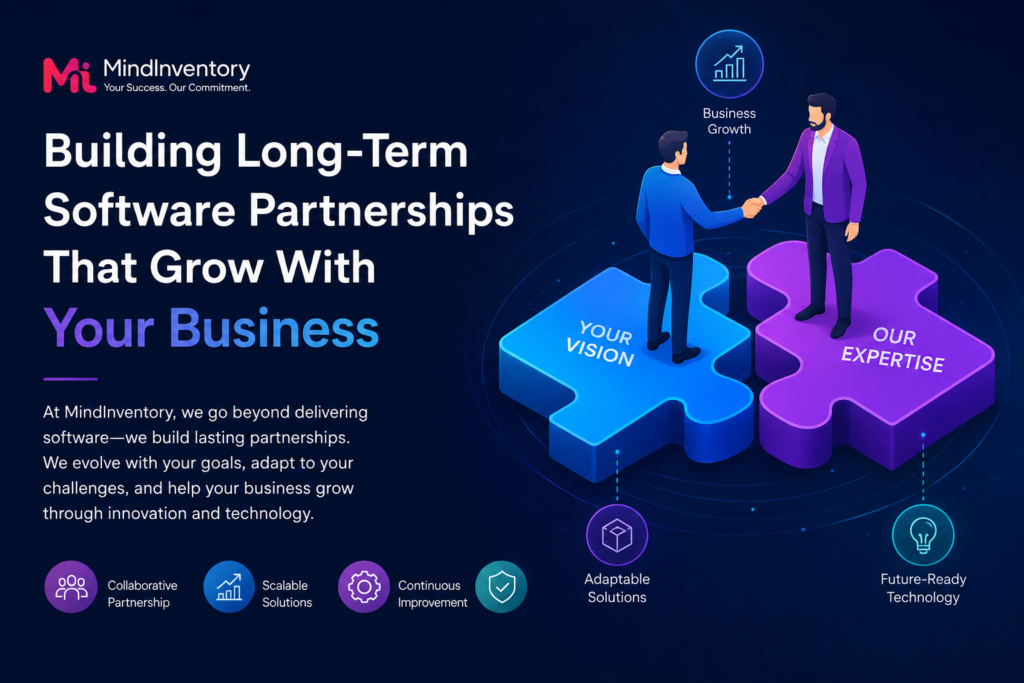
Many companies begin a software development project looking for a vendor to build an application. But as their business grows, priorities shift. New customer expectations emerge, markets change, technologies evolve, and products require continuous improvement. In these situations, businesses often realize they need more than a development team; they need a long-term technology partner.
This is where long-term software development partnerships create lasting value.
Rather than treating software delivery as a one-time engagement, MindInventory works alongside clients throughout their digital journey. From product discovery and MVP development to scaling, modernization, and ongoing optimization, the company helps businesses adapt their technology as their goals evolve.
This article explores how MindInventory builds long-term software development partnerships, the principles behind these collaborations, and real-world examples of how ongoing engagement has helped businesses stay competitive.
Why Long-Term Software Development Partnerships Matter
Launching software is only the beginning of a product’s lifecycle.
After release, businesses often need to:
- Add new features based on customer feedback
- Improve performance as usage grows
- Integrate with new platforms
- Strengthen security and compliance
- Modernize legacy systems
- Expand into new markets
- Adopt emerging technologies such as AI and automation
Working with a long-term development partner helps organizations address these changing requirements without repeatedly onboarding new teams or rebuilding institutional knowledge.
Instead of starting from scratch for every update, businesses benefit from a partner who understands their product, users, and long-term objectives.
MindInventory’s Partnership-First Approach
MindInventory approaches every engagement with the expectation that business needs will evolve over time. Rather than focusing only on project delivery, the team emphasizes collaboration, transparency, and continuous improvement.
Their partnership model generally includes:
Understanding Business Goals Before Writing Code
Every successful long-term relationship begins with understanding the business, not just the technical requirements.
Before development starts, MindInventory works to understand:
- Business objectives
- Customer challenges
- Existing workflows
- Growth plans
- Competitive landscape
- Technical constraints
This context helps ensure technology decisions support long-term business outcomes rather than short-term feature requests.
Building Software Designed for Change
Business priorities rarely remain static.
To accommodate future growth, MindInventory focuses on building software with:
- Modular architecture
- API-first development
- Cloud-native infrastructure
- Scalable backend systems
- Flexible integrations
This makes it easier to introduce new capabilities without disrupting existing operations.
Maintaining Continuous Collaboration
Long-term partnerships require ongoing communication.
MindInventory works closely with clients through:
- Regular planning sessions
- Sprint reviews
- Product roadmap discussions
- Performance monitoring
- Continuous feedback cycles
This collaborative approach helps teams adapt quickly as market conditions and customer expectations evolve.
Real Examples of Long-Term Partnerships
The following case studies illustrate how ongoing collaboration has helped businesses grow beyond the initial software launch.
Case Study 1: Helping a Healthcare Platform Grow Beyond Its MVP
The Challenge
A healthcare startup initially approached MindInventory to develop a digital platform focused on appointment scheduling and patient management.
After launch, increasing adoption created new requirements, including telemedicine capabilities, secure communication, analytics, and compliance updates.
The Partnership
Rather than ending after the first release, MindInventory continued working with the client to:
- Expand platform functionality
- Improve system performance
- Introduce telehealth features
- Strengthen data security
- Optimize user experience
- Support regulatory compliance
Business Outcome
The healthcare platform evolved into a comprehensive digital ecosystem capable of supporting a growing user base while delivering a better experience for both patients and healthcare providers.
Case Study 2: Scaling a Logistics Solution with Business Growth
The Challenge
A logistics company initially needed a transportation management solution to streamline dispatch operations.
As the business expanded into new regions, additional capabilities became necessary.
The Partnership
MindInventory helped the company continuously enhance the platform by introducing:
- Route optimization
- Real-time fleet tracking
- Driver mobile applications
- Warehouse integrations
- Business analytics dashboards
- Customer shipment tracking
Business Outcome
Because the platform evolved alongside the business, the company was able to manage increasing shipment volumes without replacing its existing software.
Case Study 3: Supporting a Startup from MVP to Enterprise Product
The Challenge
A startup launched its first version of a SaaS product with a limited feature set.
As customer adoption increased, the original architecture began showing scalability limitations.
The Partnership
MindInventory continued supporting the product by:
- Modernizing application architecture
- Improving infrastructure scalability
- Enhancing security
- Redesigning user experience
- Adding enterprise-grade capabilities
- Optimizing application performance
Business Outcome
The startup successfully transitioned from an early-stage MVP to a mature product capable of serving a significantly larger customer base.
Case Study 4: Modernizing Enterprise Systems Over Time
The Challenge
An enterprise organization operated multiple legacy applications that limited operational efficiency.
Replacing every system simultaneously wasn’t practical.
The Partnership
MindInventory worked with the organization over multiple development phases, helping to:
- Modernize legacy applications
- Integrate business systems
- Improve reporting capabilities
- Automate workflows
- Introduce cloud infrastructure
- Enhance security practices
Business Outcome
Instead of a risky large-scale replacement, the business modernized gradually while maintaining operational continuity.
What Makes Long-Term Partnerships Successful?
Across different industries, several common principles contribute to successful long-term collaborations.
Shared Understanding of Business Goals
Technology decisions become more effective when development teams understand how the business creates value.
MindInventory prioritizes strategic discussions alongside technical execution.
Knowledge Retention
One major advantage of long-term collaboration is continuity.
The same development team retains deep knowledge of:
- Product architecture
- Customer workflows
- Business priorities
- Technical history
This reduces onboarding time and improves development efficiency.
Flexible Resource Scaling
Business needs fluctuate over time.
MindInventory supports clients by scaling development teams based on project requirements, allowing organizations to respond quickly without maintaining large in-house teams.
Continuous Product Improvement
Rather than waiting for major redesigns, software evolves through incremental improvements such as:
- Feature releases
- Performance optimization
- Security updates
- UX enhancements
- Infrastructure upgrades
This helps products remain competitive over time.
Transparency Throughout the Process
Successful partnerships rely on clear communication.
MindInventory emphasizes:
- Regular progress updates
- Collaborative planning
- Shared roadmaps
- Transparent reporting
- Continuous stakeholder involvement
This alignment helps reduce project risks and supports informed decision-making.
Industries Benefiting from Long-Term Technology Partnerships
MindInventory has established ongoing development partnerships across a wide range of industries, including:
- Healthcare
- FinTech
- Logistics
- Retail
- Manufacturing
- Education
- Real Estate
- Travel & Hospitality
- SaaS
- Media & Entertainment
Although each industry faces unique challenges, the common objective is building software that continues to evolve as business needs change.
Lessons Businesses Can Learn
Organizations looking to build lasting software products can take away several important lessons:
- Choose a technology partner that understands your business strategy, not just your technical requirements.
- Invest in scalable architecture early to reduce future redevelopment costs.
- View software as an evolving business asset rather than a one-time project.
- Maintain continuous feedback between business stakeholders and development teams.
- Plan for ongoing optimization, not just initial delivery.
These practices help organizations remain agile while reducing the cost and complexity of future growth.
Why Businesses Continue Working with MindInventory
Many clients extend their engagement with MindInventory because the relationship goes beyond software development. The team acts as a strategic technology partner, helping businesses navigate changing market demands, adopt new technologies, and continuously improve their digital products.
Key strengths that support these long-term partnerships include:
- Business-first discovery and planning
- Experienced cross-functional teams
- Agile development practices
- Scalable cloud-native architecture
- Transparent communication
- Continuous product enhancement
- Expertise across multiple industries and technologies
This combination enables organizations to build software that not only solves today’s challenges but also adapts to tomorrow’s opportunities.
Final Thoughts
Building successful software is rarely a one-time effort. As businesses grow, customer expectations evolve, and technology advances, digital products must continuously adapt to remain effective. Companies that treat software development as an ongoing
are often better equipped to respond to these changes without disrupting operations or losing momentum.
MindInventory’s long-term collaborations with startups, growing businesses, and enterprises demonstrate the value of combining technical expertise with a deep understanding of business objectives. Through continuous product improvement, scalable architecture, and close collaboration, the company helps clients evolve their software alongside their business whether that’s expanding a healthcare platform, modernizing enterprise systems, scaling a logistics solution, or transforming an MVP into a mature SaaS product.
For organizations seeking sustainable digital growth, choosing a software development partner committed to long-term success can be just as important as the technology itself.