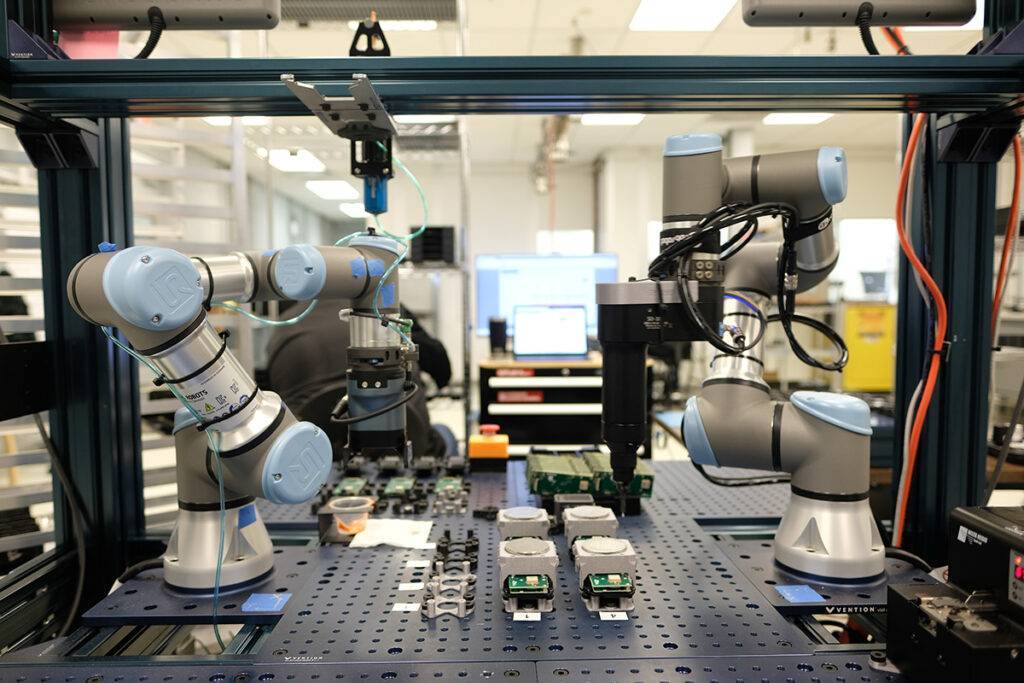
Artificial intelligence (AI) has transformed how machines perceive the world. AI technologies can do what had been the domain of human intelligence, from self-driving cars and automated manufacturing systems to health care diagnostics and security monitoring. The vision system development in artificial intelligence is one of the biggest breakthroughs in this area.
With a vision system, machines can interpret, analyze and comprehend visual information from their environment. Just as humans use their eyes and brains to recognize objects, identify patterns, and make decisions, AI-powered vision systems use cameras, sensors, algorithms, and machine learning models to process visual data and make decisions accordingly.
With industries shifting towards automation and smart technology, AI vision systems are leading the way in improving efficiency, accuracy, and decision-making. Understanding how they work and the benefits they provide can help businesses appreciate their growing importance across a range of sectors.
Understanding a Vision System in Artificial Intelligence
A vision system in artificial intelligence refers to a technology that enables machines to acquire, process, and interpret visual information. It combines hardware components such as cameras and sensors with advanced software algorithms capable of analyzing images and video streams.
The goal of an AI vision system is to emulate human vision, but often at a faster rate and with more accuracy than humans. They can see objects, find defects, recognize faces, track movement, understand scenes and make decisions in real time from what they see.
Unlike traditional machine vision systems, which are rule-based, AI-based vision systems learn from data. They apply machine learning and deep learning techniques to continually enhance their pattern recognition and adaptation to evolving environments.
This flexibility is what makes AI vision systems useful in a broad variety of industries and applications.
The Core Components of an AI Vision System
The vision system works via a set of interrelated elements to process visual information effectively.
The first part is the image acquisition. Cameras and sensors take images of the surrounding environment. The accuracy of the system depends on the quality of these devices.
The visual data is captured and then processed. Sophisticated software analyses the images, extracting the information that is relevant. These could be edge detection, shape recognition, dimension measurement, object identification or motion tracking.
The processed data are then interpreted using artificial intelligence algorithms. Machine learning models look at visual information and compare it to what they have learned previously to identify what they are seeing.
Finally the system outputs or acts . This could be raising an alarm, running a machine, identifying a product or making a decision on operations.
Together, these elements allow AI systems to process and respond to visual information efficiently.
How Artificial Intelligence Improves Vision Systems
Most traditional machine vision systems require extensive programming and predefined rules to work efficiently. These systems can perform repetitive tasks reliably, but may not cope well with changing conditions or unexpected situations.
These limitations are overcome by vision systems in artificial intelligence using learning-based approaches. These AI systems don’t just use fixed rules. They learn from large datasets with images and examples.
Image recognition and analysis have an important role in deep learning models, especially convolutional neural networks (CNNs). These models find patterns in visual data and get better and better at their job as they train.
A larger amount of data improves the system’s ability to recognize objects, to detect subtle differences and to make good decisions in complex environments.
This adaptability is one of the primary reasons AI vision systems are becoming increasingly popular across industries.
Applications in Manufacturing
Manufacturing is one of the leading industries using AI vision technology. Companies use vision systems to improve quality control, boost productivity and reduce the cost of operations.
AI-powered cameras can quickly inspect products and detect defects that human inspectors may find difficult to spot consistently. They can detect scratches, cracks, misalignments, missing parts and other quality problems in real time.
Vision systems also allow for robotic automation by helping machines identify objects, navigate environments and conduct precise assembly tasks.
Modern manufacturing facilities benefit greatly from AI vision systems, which are able to work continuously with a high degree of accuracy.
Applications in Transportation and Autonomous Vehicles
AI vision systems are key to safe navigation of autonomous vehicles. Cameras and sensors continuously monitor the surrounding environment, detecting roads, traffic signs, pedestrians, vehicles and obstacles.
This data is processed by the vision system in real-time and allows the vehicle to make driving decisions based on the current conditions.
Advanced vision technologies also underpin driver-assistance systems such as lane departure warnings, collision avoidance, adaptive cruise control and pedestrian detection.
These capabilities improve safety and increase transportation efficiency.
Applications in Healthcare
Medical imaging and diagnostic assistance is a growing area for AI vision systems in healthcare organizations.
AI algorithms can also analyze X-rays, MRIs, CT scans and other medical images to find abnormalities and help with clinical decision-making. Some AI systems can recognize diseases before traditional diagnostic methods.
Vision systems are also used in surgical procedures, patient monitoring and laboratory analysis.
AI vision technologies allow healthcare professionals to enhance their accuracy and reduce their diagnostic workloads, which leads to better patient outcomes.
Security and Surveillance Applications
Security is another area where the vision system in artificial intelligence has become extremely valuable.
AI-powered surveillance systems can monitor facilities, identify suspicious behavior, recognize faces, detect unauthorized access, and track movement in real time.
Unlike traditional security systems that rely heavily on human observation, AI vision systems automatically analyze video feeds and generate alerts when unusual activity is detected.
This capability improves response times and enhances overall security effectiveness.
Organizations across government, transportation, retail, and critical infrastructure sectors are increasingly adopting these technologies.
The Role of Edge Computing
One of the latest trends in AI vision technology is the use of edge computing. Instead, edge-enabled systems analyze the data on the local device rather than sending it to centralized servers to be processed.
This reduces latency, gives faster responses and uses less bandwidth.
Edge computing is especially useful for applications that require real-time decision making, such as industrial automation, autonomous vehicles, and security monitoring.
By combining AI vision with edge processing, operations become faster and more efficient.
Benefits of AI Vision Systems
The AI vision systems have many advantages that make it attractive for the widespread adoption.
Such systems provide excellent speed and accuracy in handling large volumes of visual data. They reduce human error, increase consistency and allow for real-time decision making.
AI vision systems are also never tired and therefore well suited to use in demanding environments where dependability is critical.
Their ability to learn and their agility also enable organizations to take on more complex challenges while improving operational efficiency.
Future Trends in AI Vision Technology
The future of AI vision systems looks very promising. Advances in machine learning, sensor technology, edge computing and artificial intelligence will further improve system performance.
Future systems will offer higher accuracy, faster processing speeds and improved contextual understanding. They will be able to understand complex scenes and act on their own more and more.
Industries like manufacturing, healthcare, transportation, logistics, agriculture, and security are set to adopt AI vision technologies even more widely.
As innovation speeds up, vision systems will be a fundamental part of intelligent automation solutions worldwide.
Conclusion
An artificial intelligence vision system allows machines to see, interpret and react to visual information in a manner similar to human perception. These systems combine cameras, sensors, machine learning algorithms and advanced computing technologies to provide powerful capabilities for supporting automation, quality control, safety and decision-making.
AI vision systems are transforming industries from manufacturing and healthcare to transportation and security through improved accuracy, efficiency and operational performance. These systems will be vital to the future of intelligent automation as technology advances.
If your organization is exploring advanced AI-powered vision solutions, Hellbender can help. Their expertise in intelligent imaging, edge computing, and AI-driven systems enables businesses to implement cutting-edge technologies that deliver measurable results.