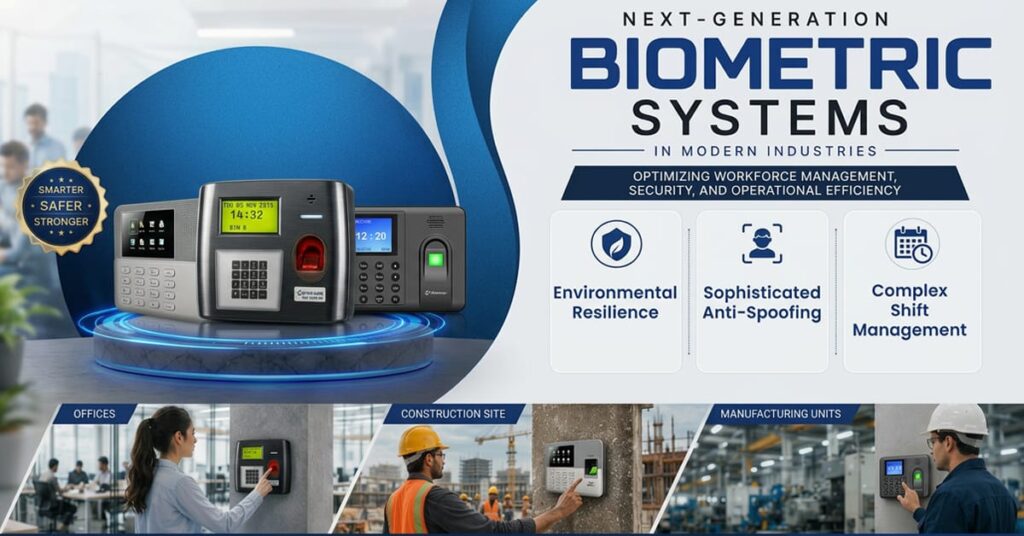
OPTIMIZING WORKFORCE MANAGEMENT, SECURITY, AND OPERATIONAL EFFICIENCY
Traditional methods of time tracking—such as manual registers, punch cards, or basic proximity badges—are no longer sufficient to meet the demands of high-throughput environments. Today, industrial facilities are increasingly turning to advanced biometric systems as a foundational technology to streamline workforce attendance, prevent time fraud, and enforce strict access control protocols.
The Shift to Multi-Modal Hybrid Biometrics
Historically, fingerprint verification was the standard for biometric authentication. However, heavy industrial environments present distinct operational challenges. Labourers and technical staff frequently work with grease, heavy machinery, chemical substances, or abrasive materials, which can lead to worn, cut, or soiled fingerprints. In a single-technology setup, this results in high False Rejection Rates (FRR), leading to long queues and bottlenecks during major shift changes.
To overcome these limitations, the current best practice in industrial sectors favors Hybrid Multi-Modal Biometric Systems. These systems combine multiple authentication factors—primarily Artificial Intelligence (AI)-powered contactless face recognition, fingerprint scanning, and Radio Frequency Identification (RFID) microchips—into a unified hardware ecosystem. This redundancy ensures that if a worker’s physical state temporarily impedes one biometric channel, an alternative method can instantly complete the verification process without administrative delays.
Industrial Paradigm Shift
Modern infrastructure now relies heavily on automated push-data technology and native cloud integration, feeding real-time attendance logs directly into Enterprise Resource Planning (ERP) platforms like SAP or localized HRMS systems.
Key Technology Requirements for Industrial Settings
When deploying biometric solutions within factory floors, heavy processing units, or construction zones, standard commercial-grade hardware falls short. Systems must fulfill several critical industrial benchmarks:
Contactless and Hygienic Throughput
High-speed AI face recognition algorithms can authenticate personnel in under 0.3 seconds, supporting rapid traffic flow during high-volume shift changes while eliminating the risk of cross-contamination.
Environmental Resilience
Hardware must feature ruggedized enclosures, often carrying IP65 ratings to protect sensitive optical sensors and internal processing boards against dust, moisture, and high ambient vibrations.
Sophisticated Anti-Spoofing
Industrial access control points require live-detection subroutines to counter artificial spoofs, such as high-resolution photographs or digital displays presented to cameras.
Complex Shift Management
Industrial operations routinely utilize overnight rotations, flexible break windows, and overlapping shifts. The underlying software must seamlessly calculate complex attendance logic automatically.
Leading Global and Enterprise Solutions
| Manufacturer | Core Strengths & Specializations | Primary Industrial Deployment |
| ZKTeco (uFace & MB Series) | Multi-modal powerhouse utilizing concurrent face, fingerprint, and RFID verification with built-in hardware anti-spoofing. | High-capacity factory gates, high-traffic labor terminals, and multi-shift manufacturing plants. |
| Matrix Comsec (COSEC Series) | Premium enterprise-grade integration with robust IP65-rated dustproof and waterproof devices designed for architectural and industrial access controls. | High-security production zones, automated flap barriers, turnstiles, and heavy engineering facilities. |
| eSSL (Airface Series) | High-capacity standalone face recognition terminals supporting expansive databases of up to 10,000 unique templates with high cost-efficiency. | Commercial assembly lines, mid-to-large scale warehouses, and distributed logistics hubs. |
| Mantra Softech (BioFace) | Exceptional optical and national ID-grade sensor accuracy built on reliable sovereign biometric infrastructure. | Government-linked infrastructure projects, heavy industrial plants, and highly regulated manufacturing sectors. |
| Star Link Communication | Heavy-duty metallic enclosures, native push-data mechanisms, and highly customizable proprietary payroll integration engines. | Complex rotational shift structures, localized heavy manufacturing, and multi-location corporate plants. |
The Role of Star Link Communication in Heavy Industry
Among the prominent solutions available, Star Link Communication has established a major presence by designing biometric platforms specifically engineered for harsh operating environments. Rather than adapting commercial office equipment for factory use, their hardware architecture focuses on heavy-duty resiliency.
Models such as the Bio Lynx series utilize durable metallic chassis and robust internal frameworks capable of enduring physical impacts, severe dust accumulation, and fluctuating voltage levels common on industrial production floors.
Furthermore, their systems are heavily integrated with Real-Time Push Data Technology. Rather than forcing administrators to manually pull logs from individual devices at the end of a weekly or monthly cycle, the hardware instantly transmits every transactional punch to a centralized cloud or on-premise server.
This architecture is crucial for facilities operating across multiple geographic regions, allowing central operations to monitor active attendance, safety compliance, and shift distribution from a single corporate dashboard.
Advanced Software Customization
A significant bottleneck in industrial automation is the integration layer between biometric readers and back-end salary computation. Star Link resolves this by supplying highly adaptable payroll and attendance logic modules natively designed to manage complex rotational rosters, night shift differentials, overtime calculations, and mandated rest periods.
By eliminating manual data intervention, these systems effectively mitigate clerical errors, prevent time-theft practices like “buddy punching,” and significantly reduce administrative overhead.
Conclusion
The selection of an industrial biometric system requires balancing physical hardware durability with advanced multi-modal software capabilities. As organizations continue to embrace automated workflows, relying on a combination of contactless AI facial recognition, robust physical build quality, and real-time ERP integration represents the gold standard for securing assets and managing large-scale industrial workforces efficiently.