
Artificial intelligence is no longer an experimental initiative sitting inside innovation labs. It has become a business priority.
Executives across industries are under pressure to automate workflows, improve customer experiences, reduce operational costs, and unlock new revenue streams using AI. But before investing, leadership teams face a critical strategic question:
Should we build an AI solution or buy one?
The answer is not always obvious.
Buying an AI platform can accelerate deployment and reduce upfront complexity. Building a custom solution can create competitive differentiation, tighter security, and long-term value. Choosing the wrong path often results in overspending, slow adoption, poor scalability, or vendor lock-in.
This executive guide breaks down the business case for build vs buy AI decisions, helping leaders understand when each approach makes sense and the factors that should influence the decision.
Why the Build vs Buy AI Decision Matters in 2026
AI adoption is accelerating, but expectations are changing.
Companies are no longer asking whether they should use AI they are deciding how deeply AI should become embedded into products, operations, customer experiences, and decision-making.
The wrong decision can create long-term problems:
- Expensive implementation failures
- Limited flexibility for future growth
- Security and compliance concerns
- Rising subscription costs
- Poor integration with internal systems
- Reduced competitive differentiation
Executives need a structured framework to evaluate AI investments based on business goals not hype.
What Does “Build vs Buy AI” Mean?
At a high level, organizations have two choices:
Build AI
Develop a custom AI solution internally or with external engineering support.
This approach gives businesses greater control over functionality, integrations, training data, and intellectual property.
Example:
A logistics company develops a predictive route optimization system tailored to its proprietary operational data.
Buy AI
Purchase or subscribe to a ready-made AI platform, SaaS product, or enterprise solution.
This approach prioritizes speed, convenience, and lower implementation effort.
Example:
A customer support company licenses an AI chatbot platform instead of building one from scratch.
The right choice depends on your priorities.
Build vs Buy AI: Quick Executive Comparison
|
Decision Factor |
Build AI |
Buy AI |
|
Time-to-market |
Slower |
Faster |
|
Customization |
High |
Limited |
|
Upfront cost |
Higher |
Lower |
|
Long-term ownership |
Full control |
Vendor dependent |
| Integration flexibility | High |
Moderate |
|
Competitive differentiation |
Strong |
Limited |
| Compliance control | Higher |
Depends on vendor |
| Maintenance responsibility | Internal |
Vendor-managed |
| Scalability flexibility | High |
Vendor constrained |
Executive takeaway:
If speed matters most, buying often wins. If differentiation, control, or proprietary value matters, building becomes more attractive.
9 Reasons to Build vs Buy AI Solutions
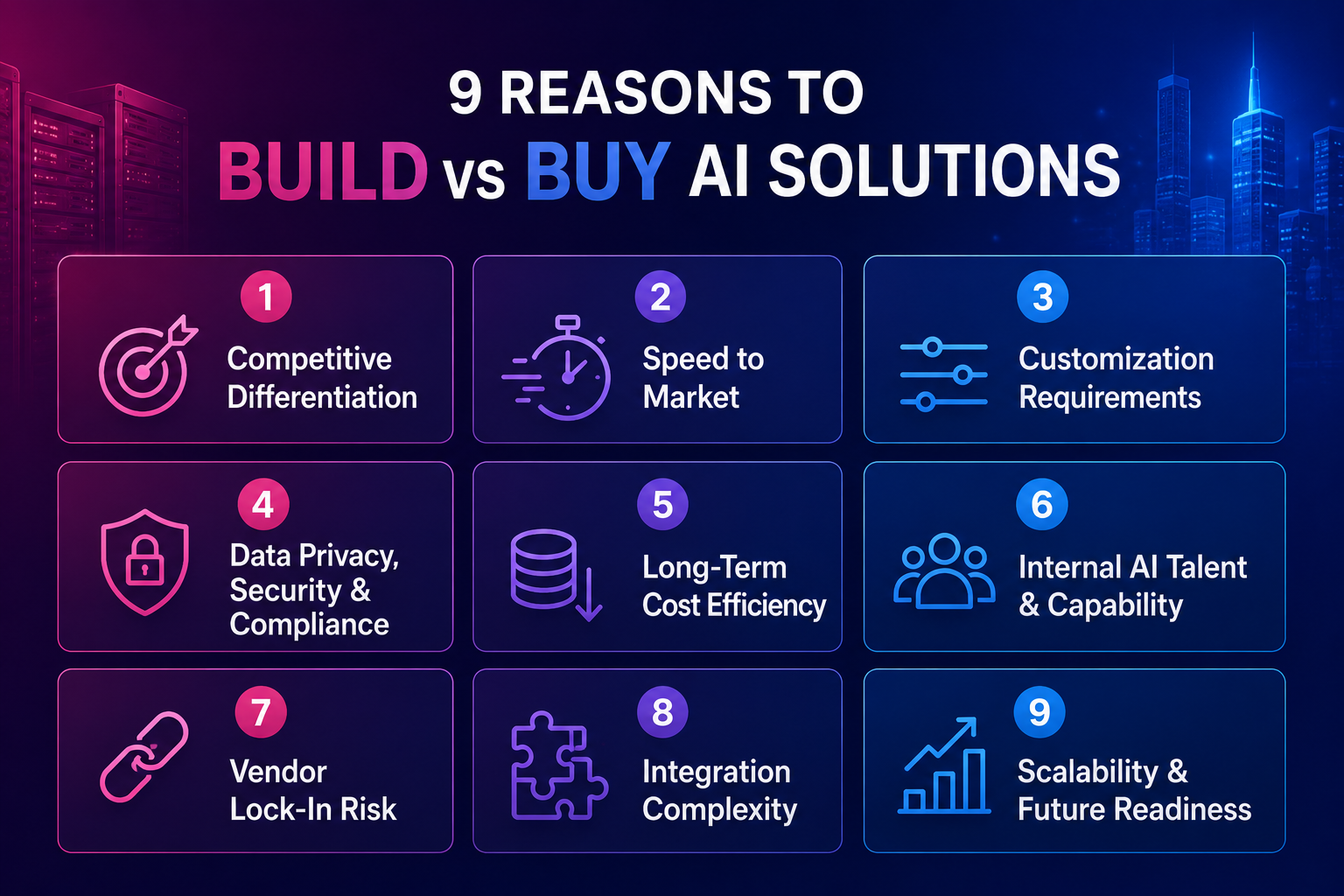
1. Competitive Differentiation
One of the strongest reasons to build AI is competitive advantage.
If AI directly influences how your business creates value, relying on the same off-the-shelf tool used by competitors may limit differentiation.
For example:
- Personalized customer recommendations
- Fraud detection systems
- Predictive maintenance
- Industry-specific automation
- Intelligent operational workflows
When AI becomes part of your unique value proposition, custom development often makes strategic sense.
When to Build
Choose build if:
- AI impacts customer experience directly
- Proprietary intelligence creates competitive advantage
- You need differentiated workflows
Organizations building unique operational capabilities often work with specialized AI Development services to accelerate implementation while reducing delivery risk.
When to Buy
Choose buy if:
- AI supports non-core business functions
- Competitive differentiation is not essential
- Speed matters more than uniqueness
2. Speed to Market
Sometimes, business urgency outweighs customization.
If leadership needs results quickly, buying AI is often the better decision.
Prebuilt platforms reduce:
- Development cycles
- Infrastructure setup
- Testing effort
- Deployment timelines
Instead of waiting months to build models and workflows, companies can launch in weeks.
Examples of strong buy scenarios:
- Internal productivity tools
- Customer support automation
- Sales assistants
- Marketing intelligence
When to Buy
Choose buy if:
- Rapid deployment matters
- Market timing is critical
- Teams need immediate productivity gains
When to Build
Choose build if:
- Long-term differentiation outweighs short-term speed
- Your workflows are too complex for generic software
3. Customization Requirements
Not every business process fits inside a standardized software template.
Enterprise operations often include:
- Complex workflows
- Industry-specific compliance requirements
- Legacy systems
- Unique datasets
- Specialized business rules
In these situations, prebuilt AI tools may force organizations to adapt processes around software limitations.
Custom AI offers greater flexibility.
For example, a healthcare organization may need domain-specific decision support aligned with internal processes and governance requirements.
When to Build
Choose build if:
- Existing tools do not match operational workflows
- Deep integrations are required
- Custom outputs matter
Companies creating enterprise copilots, internal assistants, or domain-specific automation often invest in Generative AI Development to produce secure and context-aware outputs.
When to Buy
Choose buy if:
- Standardized functionality is enough
- Minor customization meets business goals
4. Data Privacy, Security, and Compliance
Security concerns often change the decision.
Highly regulated industries including finance, healthcare, insurance, and enterprise SaaS must evaluate:
- Data residency
- Regulatory obligations
- Audit requirements
- Model transparency
- Sensitive data exposure
Buying third-party AI tools may introduce risk if vendors process sensitive information externally or fail compliance requirements.
Building AI provides more control over:
- Data governance
- Hosting environments
- Access permissions
- Security architecture
When to Build
Choose build if:
- Sensitive data is involved
- Compliance requirements are strict
- Governance and auditability matter
When to Buy
Choose buy if:
- Vendor compliance already satisfies requirements
- Security needs are lower-risk
5. Long-Term Cost Efficiency
Many executives evaluate AI decisions based on upfront cost alone.
This is a mistake.
Buying AI often appears cheaper initially because subscription pricing reduces early investment. However, long-term licensing costs can rise significantly as usage increases, users expand, or enterprise functionality becomes necessary.
Building AI generally requires:
- Higher upfront investment
- Engineering resources
- Infrastructure costs
- Ongoing maintenance
But over time, organizations may gain stronger cost efficiency especially if AI becomes deeply embedded into operations.
Think in Total Cost of Ownership (TCO)
Instead of asking:
“What costs less today?”
Ask:
“What delivers better value over three to five years?”
When to Build
Choose build if:
- AI will scale across departments
- Usage volume will grow significantly
- Long-term ownership matters
When to Buy
Choose buy if:
- AI solves a short-term business problem
- Budget predictability matters
- Usage remains limited
6. Internal AI Talent and Capability
A custom AI solution requires expertise.
Before choosing to build, executives should evaluate whether the organization has:
- AI engineers
- Data scientists
- MLOps capabilities
- Product leadership
- Infrastructure readiness
Building without operational maturity creates delays and technical debt.
In some situations, buying AI reduces risk because vendors handle:
- Updates
- Infrastructure
- Model improvements
- Performance optimization
When to Build
Choose build if:
- Strong technical capability exists
- Internal teams can maintain and evolve systems
- AI is strategically important
When to Buy
Choose buy if:
- Internal expertise is limited
- Teams need fast implementation
- Maintenance complexity is a concern
7. Vendor Lock-In Risk
Buying AI can create dependency.
Over time, organizations may become tightly tied to a vendor’s:
- Pricing model
- APIs
- Infrastructure
- Data policies
- Feature roadmap
This can limit flexibility.
For example:
A company that deeply integrates an external AI platform into workflows may struggle to migrate later without disruption.
Executives should ask:
“What happens if we outgrow this vendor?”
Or:
“How difficult would it be to switch?”
When to Build
Choose build if:
- Long-term independence matters
- Strategic control is essential
- Vendor dependency introduces business risk
When to Buy
Choose buy if:
- Switching costs remain manageable
- AI is not mission critical
8. Integration Complexity
AI rarely operates in isolation.
It must integrate with:
- ERP systems
- CRM platforms
- Internal databases
- Knowledge repositories
- Operational software
Prebuilt AI solutions may offer APIs, but integration flexibility can still be limited.
Custom AI allows tighter alignment with existing business architecture.
For enterprises operating in complex environments, integration can become a major decision factor.
When to Build
Choose build if:
- Deep integration matters
- Existing systems are highly customized
- AI must support complex workflows
When to Buy
Choose buy if:
- Plug-and-play functionality works
- Workflow complexity is limited
9. Scalability and Future Readiness
The AI solution you choose today should still support business growth tomorrow.
Executives should evaluate:
- Can the system scale with demand?
- Will it support new use cases?
- Can it evolve with business priorities?
- Will customization limits become a bottleneck?
Buying AI may work initially but become restrictive later.
Building provides flexibility for expansion but requires stronger governance and investment.
When to Build
Choose build if:
- AI will become core infrastructure
- Future flexibility matters
- Long-term scalability is critical
When to Buy
Choose buy if:
- AI needs are narrow
- Use cases are unlikely to expand significantly
Executive Decision Framework: When to Build vs Buy AI
If you are unsure which path to choose, use this decision matrix.
|
Business Scenario |
Build |
Buy |
|
Need faster implementation |
✓ |
|
|
Competitive differentiation matters |
✓ |
|
|
Sensitive data or strict compliance |
✓ |
|
|
Limited internal expertise |
✓ |
|
|
Standardized business workflows |
✓ |
|
|
Deep integrations required |
✓ |
|
|
AI is business critical |
✓ |
|
|
Short-term experimentation |
✓ |
|
|
Long-term ownership matters |
✓ |
Executive shortcut:
- Buy AI when speed, convenience, and lower implementation effort matter most.
- Build AI when differentiation, control, scalability, and strategic value matter more.
Common Mistakes Executives Make When Choosing AI
1. Focusing Only on Upfront Cost
A cheaper subscription today may become expensive at enterprise scale.
Evaluate total cost of ownership.
2. Ignoring Integration Complexity
Many AI implementations fail because tools do not fit existing systems.
Integration planning matters.
3. Overbuilding Too Early
Not every use case requires custom AI.
Sometimes buying first helps validate business value.
4. Underestimating Governance Requirements
Security, compliance, and auditability become critical as AI adoption grows.
5. Choosing Generic Tools for Strategic Workflows
If AI drives competitive advantage, relying entirely on standardized software may limit innovation.
Executive Checklist: Should You Build or Buy AI?
Ask these questions:
✔ Does AI create competitive differentiation?
✔ Do we need deployment speed?
✔ Is sensitive or regulated data involved?
✔ Do we have internal expertise to maintain AI?
✔ Will this scale across the organization?
✔ Are we comfortable depending on a vendor long term?
✔ Do we need deep integration with internal systems?
If most answers lean toward control, customization, and strategic ownership, building is likely the better route.
If speed, convenience, and simplicity dominate, buying often makes more sense.
FAQs
Should businesses build or buy AI solutions?
It depends on business goals, timeline, customization needs, compliance requirements, and internal expertise. Companies focused on speed often buy AI, while organizations seeking competitive differentiation frequently build custom solutions.
When should a company build a custom AI solution?
Businesses should consider building AI when proprietary workflows, unique data, compliance needs, or long-term competitive advantage are important.
When is buying an AI solution the better option?
Buying AI is usually the better option when fast deployment, lower upfront investment, and reduced implementation complexity matter most.
Is building AI more expensive than buying?
In the short term, yes. Building typically requires higher upfront investment. However, over time, custom AI can become more cost-effective depending on scale, licensing costs, and ownership needs.
What are the risks of buying third-party AI software?
Common risks include vendor lock-in, limited customization, compliance concerns, pricing changes, and integration limitations.
Can companies start by buying AI and later build custom solutions?
Yes. Many organizations use purchased AI tools to validate business value before investing in custom systems.
How do executives decide between build vs buy AI?
Executives should evaluate speed, business goals, internal capability, compliance requirements, total cost of ownership, scalability, and competitive differentiation.
Final Thoughts
There is no universal answer to the build vs buy AI debate.
The right choice depends on what AI means to your business.
If AI supports standardized workflows and speed matters most, buying is often the smarter move.
If AI will become a core strategic capability, power differentiated customer experiences, or rely on proprietary data, building may generate greater long-term value.
The best executive decisions are rarely driven by hype. They are driven by business outcomes, operational reality, and long-term strategic fit.