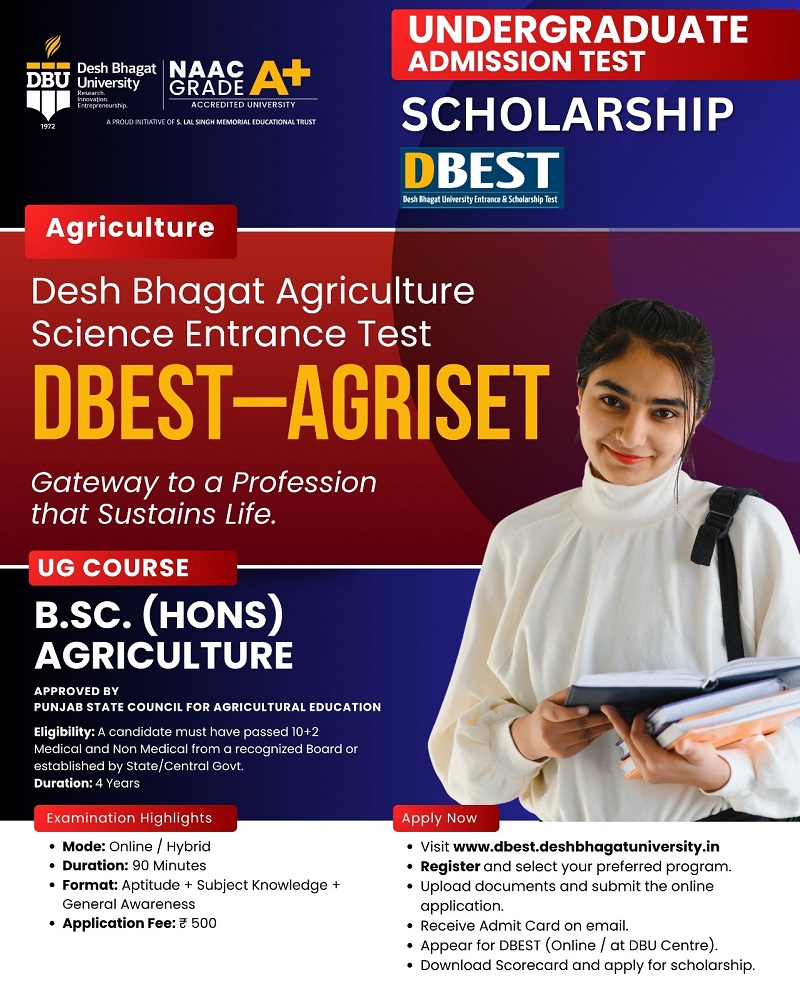
Agriculture is one of the fastest-growing educational fields in India. Many students choose agriculture courses because the sector offers good career opportunities in farming, research, food production, and agribusiness. To get admission into agriculture programs, students often need to qualify for a BSc Agriculture entrance exam.
At Desh Bhagat University, students interested in agriculture education can prepare for a successful future through quality academic learning and practical training. Understanding the entrance exam process is important for students who want to study agriculture professionally.
What is a BSc Agriculture Entrance Exam?
A BSc Agriculture entrance exam is conducted for admission into undergraduate agriculture programs. The exam checks a student’s knowledge in science subjects and evaluates their understanding of basic concepts related to Physics, Chemistry, Biology, and Agriculture.
The purpose of the entrance exam is to select students who are interested in agricultural science and capable of handling professional agriculture studies.
Students who clear the examination can apply for admission to agriculture degree programs.
Eligibility for BSc Agriculture Entrance Exam
Students who want to appear for a BSc Agriculture entrance exam generally need to complete 10+2 education from a recognized board.
Science subjects are usually required, including:
- Physics
- Chemistry
- Biology
- Agriculture
- Mathematics in some cases
The minimum marks required may vary according to admission guidelines.
Students should always check official admission requirements before applying for the examination.
Subjects Included in the Entrance Exam
The syllabus for a BSc Agriculture entrance exam is mostly based on 10+2 science subjects. Important subjects generally include:
Physics
Questions may come from:
- Motion and force
- Electricity
- Light
- Thermodynamics
- Magnetism
Chemistry
Important topics include:
- Organic chemistry
- Chemical reactions
- Acids and bases
- Periodic table
- Solutions and compounds
Biology
Students may study:
- Plant biology
- Human physiology
- Genetics
- Cell structure
- Ecology
Agriculture
Some entrance exams also include agriculture-related topics such as:
- Crop production
- Soil management
- Irrigation
- Farming methods
Exam Pattern
The pattern of the BSc Agriculture entrance exam may differ according to the university or institution. However, most exams include:
- Multiple-choice questions
- Objective-type questions
- Subject-wise sections
- Time-based examinations
The exam is generally conducted in offline or online mode.
Students should understand the exam pattern carefully before preparation.
Importance of BSc Agriculture Entrance Exam
The BSc Agriculture entrance exam helps universities select students with scientific knowledge and interest in agriculture. It also encourages students to prepare seriously for higher education.
The examination process helps students:
- Improve subject knowledge
- Develop analytical thinking
- Understand agriculture concepts
- Build confidence for professional studies
A good score can help students get admission into quality agriculture programs.
Preparation Tips for BSc Agriculture Entrance Exam
Students should prepare in a proper and organized way for better performance in the examination.
Understand the Syllabus
Students should first study the complete syllabus and identify important topics.
Make a Study Schedule
A proper timetable helps students manage all subjects equally.
Practice Previous Papers
Solving old question papers helps students understand question patterns and improve speed.
Focus on NCERT Books
Basic concepts from school-level books are very important for entrance exam preparation.
Revise Regularly
Revision improves memory and helps students remember important formulas and concepts.
Improve Time Management
Students should practice mock tests to improve speed and accuracy.
Career Scope after BSc Agriculture
After qualifying for the BSc Agriculture entrance exam and completing graduation, students can explore many career opportunities.
Graduates may work in:
- Agriculture industries
- Government departments
- Food processing companies
- Research centers
- Seed industries
- Fertilizer companies
- Agribusiness sectors
Common job profiles include:
- Agriculture Officer
- Farm Manager
- Agriculture Research Assistant
- Soil Analyst
- Seed Technologist
- Agriculture Consultant
Students can also continue higher education in agriculture and related fields.
Higher Study Options
After completing BSc Agriculture, students can choose:
- MSc Agriculture
- MSc Horticulture
- MBA Agribusiness
- MSc Plant Pathology
- PhD in Agriculture
Higher education helps students gain specialization and better career opportunities.
Skills Required for Agriculture Students
Students preparing for a BSc Agriculture entrance exam should develop:
- Scientific thinking
- Observation skills
- Problem-solving ability
- Communication skills
- Interest in farming and environment
These skills are useful during both academic studies and professional careers.
Importance of Agriculture Education in India
Agriculture remains one of the most important sectors in India. Modern farming now uses advanced technology, scientific research, and sustainable methods. Because of this, trained agriculture professionals are needed in different industries.
Agriculture education helps students understand modern farming systems and contribute to food security and rural development.
At Desh Bhagat University, students receive academic learning along with practical exposure that supports professional growth in the agriculture sector.
Conclusion
The BSc Agriculture entrance exam is an important step for students who want to build careers in agriculture and farming science. The examination checks knowledge of science subjects and helps students prepare for professional agriculture education.
Students who prepare with proper planning, regular practice, and strong subject understanding can perform well in the examination. After completing the course, graduates can explore careers in agriculture industries, research organizations, and government sectors. Agriculture education continues to provide strong career opportunities because of the growing importance of modern farming and food production.