Introduction
Perhaps, it’s already late and you’re scrolling at night, not really looking for anything. Then a song starts playing. You don’t know the artist. You don’t know the language fully either. Still, you don’t skip it. That’s how digital platforms work now. Not only they wait for you to search. But also, they just bring music to you. Similarly, you might have noticed this with Koyal, where local tracks show up without effort. For instance, may be the first minute you’re listening casually, the next you’ve saved three new songs.
Then it shifts again. You land on a track from Punjabi songs, and suddenly your playlist feels completely different. Same app, same session, different sound.
Digital platforms remove location limits
Not to mention that, music is no longer tied to where you live. That’s the biggest change.
As a result, digital platforms let you access songs from anywhere without extra steps. Similarly, you don’t need to search region by region. Everything sits in one place.
For instance, a track from Lahore can trend in London within days. Conversely, that speed didn’t exist before. However, when we talk about it now, it kinda feels normal.
So, if you’re building a playlist, you’re not limited anymore. Furthermore, you may also mix styles without thinking about borders.
Digital platforms push music without you searching
Apart from that, music discovery also happens automatically now. Due to that, you don’t always choose the song first.
Moreover, these digital platforms track what you play, skip, and repeat. Then they adjust your feed. That’s why new music keeps showing up without effort.
Sometimes you don’t even like the first few seconds. But then you let it play. That’s enough for it to stay in your loop.
All in all, this system works because it feels natural. You don’t feel like you’re searching. You just listen.
Artists grow faster because of digital platforms
Artists don’t wait for big labels anymore. That’s a clear shift.
With digital platforms, they upload music directly. If people like it, it spreads. If not, it fades. It’s simple.
This also means new voices show up more often. You don’t hear the same names repeatedly.
Some artists go from unknown to popular in weeks. That kind of growth was rare before.
Digital platforms support local music globally
Local music doesn’t stay local anymore. That’s the key benefit.
Digital platforms take regional sounds and place them next to global tracks. You listen to both without noticing the shift.
A folk-based song can sit next to a modern beat. And it still works.
This is how smaller music scenes grow. They don’t need separate promotion. They just need exposure.
Why digital platforms make punjabi songs more visible
Punjabi music has always had energy. Now it has reach.
Digital platforms push punjabi songs into global playlists. You hear them in gyms, cars, and even background reels.
The beat makes them easy to repeat. The language doesn’t become a barrier anymore.
Even if you don’t understand every word, you still enjoy the track. That’s why they spread fast.
How digital platforms shape listening habits
Your listening style changes without you noticing.
Not only you skip faster. But also, you decide quicker and move on if a song doesn’t click within seconds. Similarly, Digital platforms train you to expect instant connection. So, if it doesn’t happen, you don’t wait.
At the same time, you discover more music than before. Consequently, that trade-off defines modern listening.
Playlists matter more than albums now
Albums still exist, but playlists lead the experience.
Digital platforms push curated playlists based on mood or activity. You don’t always search for artists directly.
You search for “calm,” “drive,” or “focus,” and music follows.
This changes how artists release songs too. Many focus on single tracks instead of full albums.
Challenges of digital platforms for artists
Not everything works in favor of artists.
There’s more competition now. Thousands of songs release daily. Standing out becomes harder.
Also, short attention spans hurt deeper music. Songs that take time to build often get skipped.
Digital platforms reward quick impact. That changes how music is created.
How to use digital platforms better as a listener
Don’t rely only on what shows up.
Explore sections you usually ignore. Search for artists manually sometimes.
Save songs that you actually like. That improves your recommendations.
Also, revisit older tracks. Not everything good is trending.
You get better results when you guide the platform, not just follow it.
Conclusion
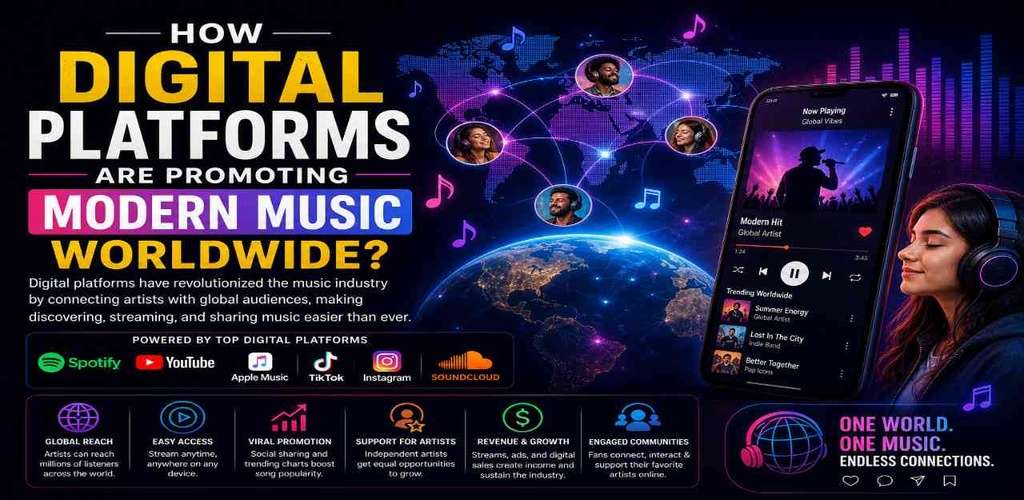
Digital platforms changed how music spreads and how you listen. They removed limits, sped up discovery, and made global access normal.
If you use them right, you won’t just hear more music. You’ll hear better music that actually fits your taste.