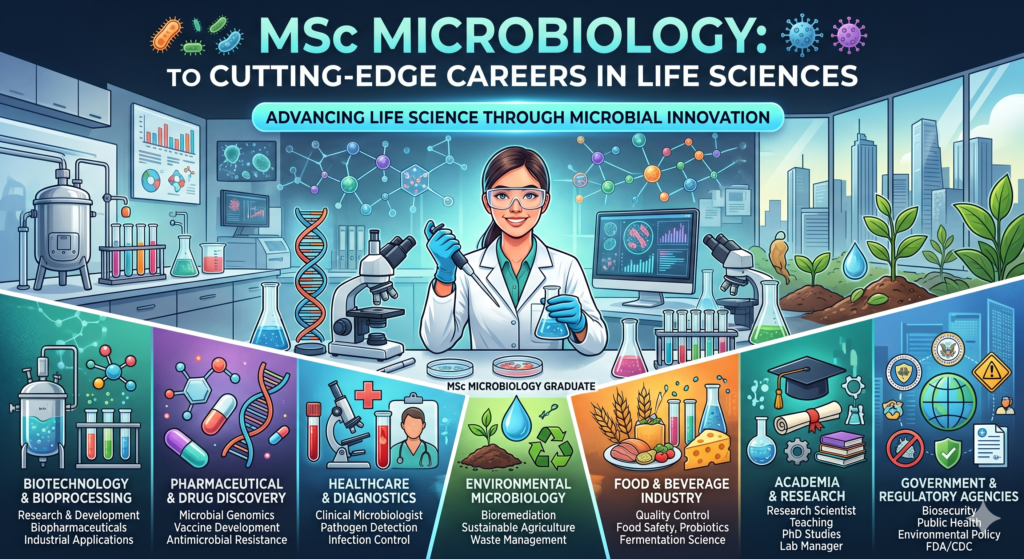
The world of microorganisms is both invisible and extraordinarily powerful. Bacteria, viruses, fungi, and other microbes influence everything from human health and agriculture to climate change and industrial manufacturing. For students passionate about the living world at its most fundamental level, pursuing an MSc Microbiology is one of the most rewarding academic and professional decisions available today. With growing demand for microbiologists across healthcare, pharmaceuticals, food science, and environmental sectors, this postgraduate degree opens doors to high-impact careers.
What Is MSc Microbiology?
MSc Microbiology is a two-year postgraduate program that builds on foundational knowledge in biology, biochemistry, and microbial sciences to equip students with advanced understanding of microbial life. The curriculum typically covers areas such as:
- Medical Microbiology and Immunology
- Environmental Microbiology
- Industrial and Food Microbiology
- Molecular Biology and Genetics
- Microbial Biotechnology
- Virology and Parasitology
- Research Methodology and Lab Techniques
Students gain both theoretical depth and hands-on laboratory experience, making them job-ready for roles in research, diagnostics, quality control, and more.
Why Microbiology Is More Relevant Than Ever
The COVID-19 pandemic brought microbiology to the forefront of public consciousness and demonstrated just how critical this field is to global health security. But even beyond pandemics, microbiologists are essential in addressing some of the most pressing challenges of our time — antibiotic resistance, food safety, water purification, biofuel development, and sustainable agriculture.
Governments, research institutions, and private companies are all significantly increasing investment in microbiological research and biotechnology. This translates into a growing demand for qualified microbiologists with advanced degrees and research experience.
Career Opportunities After MSc Microbiology
An MSc in Microbiology equips graduates for a wide variety of rewarding careers:
Pharmaceutical and Biotech Industry: Quality control, R&D, regulatory affairs, and drug development all require microbiologists. Large pharmaceutical companies hire MSc Microbiology graduates for laboratory and research roles.
Hospitals and Diagnostic Labs: Clinical microbiologists help diagnose infectious diseases, identify pathogens, and guide treatment decisions. This is a critical and stable career path.
Food and Beverage Industry: Food safety is a major concern for companies worldwide. Microbiologists test products, ensure compliance with safety standards, and develop preservation techniques.
Environmental Agencies: Government and NGO bodies employ microbiologists to monitor water and soil quality, manage waste treatment, and support biodiversity conservation.
Academia and Research: Many MSc graduates go on to pursue PhD programs and build careers in academic research, contributing to scientific knowledge in areas like antimicrobial resistance, virology, or synthetic biology.
Skills Developed During MSc Microbiology
Beyond subject knowledge, an MSc Microbiology program develops a sophisticated set of transferable skills. Students learn to design and execute experiments, analyze complex data sets, write scientific reports, and present research findings. Lab safety, precision, and attention to detail become second nature. These skills are highly valued across disciplines, making microbiology graduates versatile professionals.
Choosing the Right Institution
The quality of your MSc Microbiology program significantly influences your career trajectory. Look for institutions with well-equipped laboratories, experienced and research-active faculty, industry collaborations, and strong placement records. Programs that offer research projects, internships, or industry exposure give students a meaningful advantage when entering the job market.
Amity University, Mohali offers a postgraduate program in Microbial Sciences designed to give students both academic rigor and practical training. Located in one of India’s growing educational hubs, the institution provides access to research opportunities and a strong academic community.
Conclusion
Pursuing an MSc Microbiology is not just a qualification — it is a commitment to one of the most vital and dynamic fields in science. As the world continues to grapple with infectious diseases, food security challenges, and environmental degradation, trained microbiologists are at the forefront of finding solutions. If you’re ready to make a real difference through science, explore the postgraduate Microbial Sciences program at Amity University, Mohali, and begin your journey today.