A QUICK OVERVIEW :
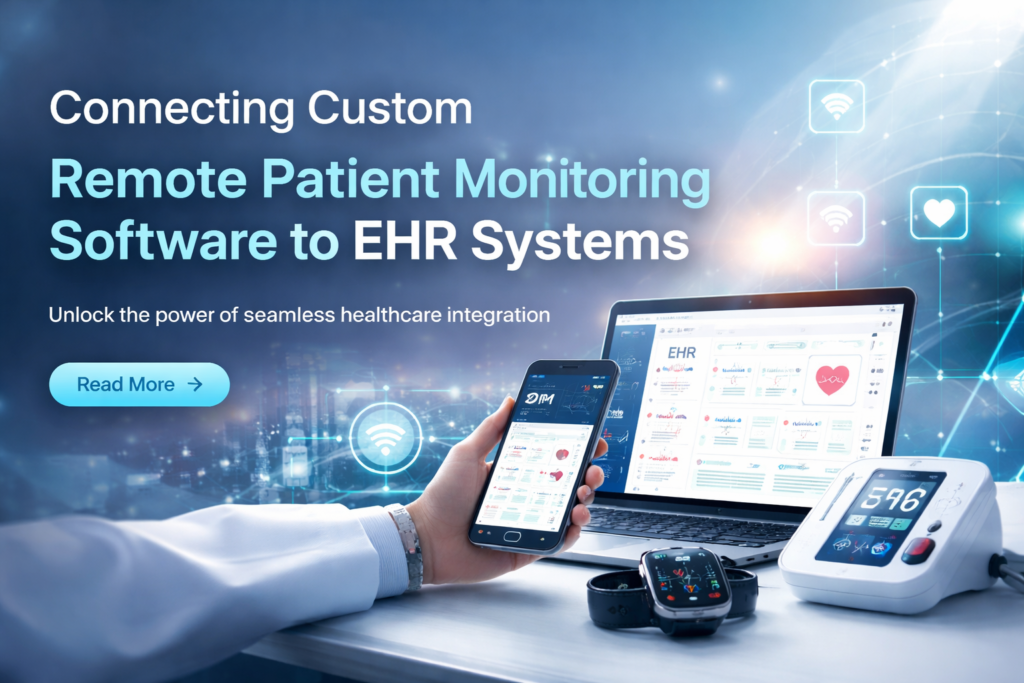
Imagine having real-time insights into your patients’ health, right from their homes, without waiting for clinic visits. That’s what happens when custom remote patient monitoring (RPM) software seamlessly connects with EHR systems. From wearables tracking heart rate to glucose meters reporting daily readings, integration ensures clinicians see accurate, actionable data instantly. In this guide, we break down how RPM and EHR systems connect, the challenges that slow integration, and the best practices to overcome them—showing how healthcare can become smarter, faster, and more patient-centric. Keep reading to discover how modern digital health is reshaping care delivery.
With the right integration, providers can anticipate health risks before they escalate and deliver personalized care at scale—turning data into meaningful outcomes for every patient.
INTRODUCTION :
Healthcare is steadily moving toward a connected, data-driven ecosystem, yet one persistent challenge continues to slow progress: seamless integration between remote patient monitoring (RPM) platforms and electronic health record (EHR) systems. For organizations investing in digital health, understanding how this connection works is not just technical curiosity, it is a strategic necessity.
This guide explores, in depth, how custom remote patient monitoring software connects to EHR systems, the standards that enable it, the bottlenecks that disrupt it, and the best practices that ensure a scalable, compliant, and future-ready solution.
Understanding the Foundations: RPM and EHR Systems
Before diving into integration, it helps to clarify the roles of each system.
Remote Patient Monitoring (RPM) software collects patient health data from connected devices such as wearables, glucometers, blood pressure monitors, and pulse oximeters. This data is transmitted in real time or at scheduled intervals to healthcare providers.
Electronic Health Record (EHR) systems, on the other hand, act as centralized repositories for patient medical histories, diagnoses, medications, lab results, and clinical workflows.
The real value emerges when these two systems communicate effectively. Without integration, clinicians must manually transfer data, increasing errors, delays, and administrative burden.
Why Integration Matters in Modern Healthcare
The connection between RPM and EHR systems is critical for several reasons:
- Real-time clinical decision-making based on continuous patient data
- Reduced hospital readmissions through proactive monitoring
- Improved patient engagement and outcomes
- Operational efficiency by eliminating manual data entry
Healthcare providers working with a custom remote patient monitoring software in Washington often prioritize EHR integration because regulatory compliance and care coordination demand accurate, synchronized data.
Core Technologies That Enable Integration
1. FHIR (Fast Healthcare Interoperability Resources)
FHIR is the modern standard for healthcare data exchange. It uses APIs to allow systems to communicate in a structured, secure, and scalable way.
FHIR enables:
- Real-time data exchange
- Standardized data formats
- Faster integration with modern applications
2. HL7 (Health Level Seven)
HL7 is a legacy but still widely used standard. Many EHR systems rely on HL7 v2 messages for data exchange.
HL7 supports:
- Structured messaging between systems
- Compatibility with older healthcare infrastructures
3. APIs (Application Programming Interfaces)
APIs act as the bridge between RPM platforms and EHR systems. They allow software applications to request, send, and update data seamlessly.
Step-by-Step: How RPM Software Connects to EHR Systems
Step 1: Data Collection from Devices
This is the initial stage where patient health data is gathered from IoT-enabled medical devices like blood pressure monitors, glucose meters, heart rate trackers, and wearable ECGs. The collected data forms the foundation for remote monitoring and is securely transmitted to the RPM platform for processing.
Step 2: Data Normalization and Structuring
Raw device data is often inconsistent or incompatible with EHR systems. Normalization involves cleaning, validating, and converting data into standardized formats (e.g., FHIR or HL7) to ensure it is accurate, consistent, and ready for integration.
Step 3: API-Based Data Transmission
In this step, the structured data is sent from the RPM platform to the EHR system through secure APIs. APIs handle authentication, authorization, secure transmission, and proper mapping of data fields, enabling automated and real-time exchange between systems.
Step 4: Integration with EHR Workflows
Once the data reaches the EHR, it is integrated into existing clinical workflows. This includes patient records, dashboards, and alerts. Clinicians can access RPM data alongside traditional clinical information, which improves decision-making and patient care efficiency.
Step 5: Feedback Loop to RPM System
Advanced RPM–EHR integrations are bi-directional, meaning the EHR can send updates back to the RPM platform. This includes care plan adjustments, medication changes, and clinical notes. The feedback loop ensures continuous, synchronized patient care and enables proactive interventions.
Common Challenges in RPM–EHR Integration
Integrating remote patient monitoring software with EHR systems is a complex process that presents several challenges, even with modern technology. Key obstacles include:
- Data Interoperability Issues: Different healthcare systems often use varying data formats, making it difficult to ensure consistent and accurate information exchange.
- Legacy EHR Systems: Many providers rely on outdated infrastructure that may not support modern APIs or FHIR standards, creating integration roadblocks.
- Security and Compliance: Healthcare data must adhere to strict regulations like HIPAA. Ensuring secure transmission, storage, and access is a critical and ongoing challenge.
- Scalability Concerns: As patient volumes grow, RPM–EHR systems must handle large amounts of real-time data without performance degradation.
- Workflow Disruption: Poorly integrated systems can overwhelm clinicians with excessive alerts or confusing data presentation, impacting care quality.
Organizations offering remote patient monitoring solution development company in Washington often tackle these challenges by building custom, tailored integration architectures. This approach ensures reliable data flow, regulatory compliance, and a seamless experience for both clinicians and patients.
Best Practices for Seamless Integration
To achieve smooth and reliable RPM–EHR integration, healthcare organizations and software providers should follow several best practices:
Adopt a FHIR-First Approach: FHIR APIs are more flexible and future-proof compared to traditional HL7-only systems, making integration faster and more scalable.
Build a Modular Architecture: A modular system allows easy updates, scalability, and integration with multiple EHR platforms without disrupting existing workflows.
Ensure Strong Data Governance: Implement robust data management practices, including:
- Data validation rules to ensure accuracy
- Audit trails for transparency and accountability
- Role-based access control to protect sensitive patient information
Focus on User Experience: Clinicians should have:
- Clear and intuitive dashboards
- Actionable insights that support clinical decisions
- Minimal alert fatigue to avoid overwhelming staff
Prioritize Security from Day One: Security measures should include:
- End-to-end encryption for data in transit and at rest
- Secure authentication protocols
- Compliance-ready infrastructure to meet HIPAA, HITECH, and other regulations
Providers offering rpm software development services in Washington often emphasize a security-first design, ensuring regulatory compliance and safeguarding sensitive patient data while delivering reliable, user-friendly solutions.
Real-World Use Case: RPM-EHR Integration in Action
Consider a patient with chronic hypertension using a home blood pressure monitor. The integration process works as follows:
- The device records daily readings and transmits the data to the RPM platform
- The RPM platform standardizes the data, often converting it into FHIR format
- Data is securely sent to the EHR system via APIs
- Clinicians receive real-time alerts if readings exceed predefined thresholds
- Treatment plans are adjusted promptly based on the incoming data
This seamless integration loop not only reduces unnecessary hospital visits but also improves patient outcomes by enabling timely interventions and continuous monitoring.
Architecture Models for Integration
1. Direct Integration
In this approach, the RPM software connects directly to the EHR system using APIs.
Pros:
- Faster data communication with minimal delays
- Lower latency for real-time monitoring
Cons:
- Difficult to scale when connecting to multiple EHR systems
- May require custom configurations for each EHR platform
2. Middleware-Based Integration
A middleware layer sits between the RPM software and the EHR, handling data exchange and transformation.
Pros:
- Better scalability across multiple EHR systems
- Simplifies data mapping and transformation between different formats
Cons:
- Adds a layer of complexity to system architecture
- Slightly higher maintenance requirements
3. Cloud-Based Integration
Integration is managed via cloud platforms that store, process, and exchange data between RPM and EHR systems.
Pros:
- Highly scalable to support large patient populations
- Enables real-time analytics and dashboards
- Simplifies remote access for providers
Cons:
- Requires robust security and compliance measures
- Dependence on cloud provider reliability and connectivity
Compliance and Regulatory Considerations
Integrating RPM software with EHR systems requires strict adherence to healthcare compliance standards to protect sensitive patient data. Key regulations include HIPAA, which ensures data privacy and security; the HITECH Act, which governs electronic health information; and GDPR for organizations handling data globally.
A robust compliance strategy should include:
- Data encryption to protect information in transit and at rest
- Role-based access control to ensure only authorized personnel can access sensitive data
- Continuous monitoring to detect and address security threats promptly
Meeting these standards is essential not only for legal compliance but also to maintain patient trust and ensure the safe, reliable operation of RPM systems.
Future Trends in RPM–EHR Integration
AI-Driven Insights
AI processes continuous RPM data within EHR systems to identify trends, predict potential health risks, and support early, data-driven clinical decisions.
Interoperability Expansion
Growing adoption of FHIR and modern APIs will improve compatibility between systems, enabling smoother and more standardized data exchange across healthcare platforms.
Patient-Centric Ecosystems
Integrated apps will allow patients to access, manage, and share their health data, leading to better engagement, transparency, and personalized care.
Real-Time Monitoring at Scale
With 5G and IoT, RPM systems will monitor large patient populations in real time, ensuring faster responses and more efficient healthcare delivery.
Conclusion
Connecting custom remote patient monitoring software in Washington to EHR systems may seem complex, but it is a critical step toward modern, data-driven healthcare. By leveraging technologies like FHIR, HL7, APIs, and secure data pipelines, healthcare organizations can create seamless, real-time data flows that empower clinicians and patients alike. While challenges such as interoperability, security, and legacy systems exist, following best practices and working with expert development services can make integration efficient and reliable.
Successful RPM–EHR integration delivers better patient outcomes, streamlined clinical workflows, and scalable digital health ecosystems. For providers aiming to stay competitive and compliant, investing in robust, future-ready integration is not just optional—it is the foundation for smarter, connected, and patient-centric care in the digital age.