Most enterprises have already experimented with AI. They have tested chatbots, automated reports, and plugged a few off-the-shelf tools into daily workflows.
But then the momentum stalls.
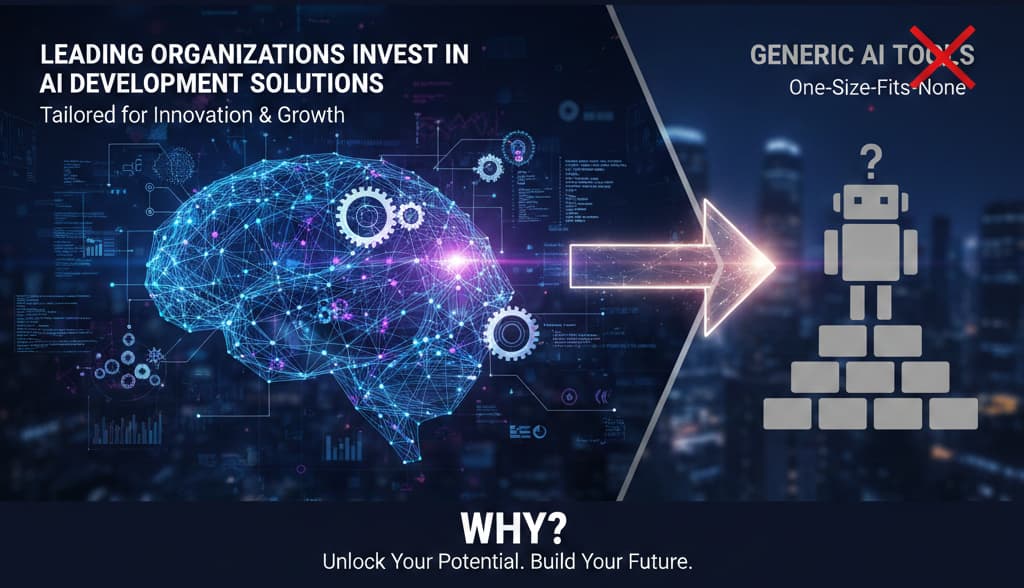
Generic AI tools deliver quick wins, but rarely sustained advantage. That is why leading organizations are moving beyond subscriptions and experimenting less. They are investing instead in artificial intelligence development services and custom AI development solutions that align with how their business runs.
This shift is not about hype. It is about control, scale, and real
The Promise and the Problem with Generic AI Tools
Generic AI tools are built for speed and broad adoption. They work well for simple use cases such as:
- Drafting content
- Summarizing documents
- Basic customer support queries
But enterprises operate in complex environments that include:
- Multiple systems
- Legacy platforms
- Strict compliance rules
- Highly specific workflows
According to McKinsey, most organizations have experimented with AI in some form. Yet only a small fraction are achieving enterprise‑wide transformation or measurable financial returns.
The gap is not access but execution.
Generic tools cannot fully understand proprietary data models, industry regulations, or operational nuance. They are trained broadly, not deeply.
That limitation becomes obvious as soon as organizations try to scale.
Why Leaders Choose AI Development Solutions Instead
Custom AI development solutions are designed around the business, not around the tool.
They reflect internal data structures, integrate with existing platforms, and evolve with business goals. That distinction is critical.
This is not about replacing tools. It is about building capability that drives meaningful outcomes.
One Size Does Not Fit All in Enterprise AI
Generic AI tools assume common problems and common answers. Enterprises rarely operate that way.
For instance, a financial services firm has very different risk models than a retail brand. A healthcare provider cannot treat data the same way a logistics company does.
Custom artificial intelligence development services allow organizations to train models on domain-specific data. They also allow fine-tuning based on real-world behavior, not generic benchmarks.
As Andrew Ng famously said,
“AI is the new electricity. It will transform every industry.”
Electricity is powerful, but only when wired correctly.
Data Ownership and Security Are Non-Negotiable
Data is the foundation on which AI is developed, but data also presents a risk.
Businesses in regulated industries cannot tolerate any ambiguity with respect to where data goes, how it’s processed, and who has access to it.
Typically, such generic AI technologies share underlying infrastructure for which assurance may be claimed by vendors. However, legal uncertainties remain for enterprises.
Bespoke AI creation changes that dynamic.
The benefit of having a trusted AI development services provider is that an organization can construct applications that operate inside its own environments, including those of private clouds, hybrid infrastructures, or on-premises systems. This guarantees that the data never moves beyond permitted boundaries.
Integration Is Where Most AI Initiatives Fail
AI does not operate in isolation. It must connect to ERP systems such as CRM platforms, data warehouses, and operational dashboards.
Generic tools struggle here. They often rely on surface-level APIs and limited customization.
Custom AI development services are designed considering integration as a key requirement, rather than an afterthought.
This is among the key reasons that enterprises prefer to deal with a specialized AI solutions development company rather than developing solutions on their own. Such companies are aware of the need to avoid a fragile implementation.
The result is AI that lives inside the workflows, not alongside the workflows.
From Experimentation to Operational AI
Many organizations are stuck in pilot mode.
They test AI, demo it, but rarely scale it.
The reason behind this is clear: scaling AI requires engineering discipline, governance, and long-term ownership.
Custom artificial intelligence development services address this gap by focusing on deployment, monitoring, retraining, and lifecycle management. These are not features you get from generic tools. They are the capabilities you build.
Custom AI Drives Measurable ROI
Leadership teams are also concerned about factors like revenue gain, cost minimization, etc.
Typically, generalized tools face difficulty proving direct ROI since they are usually not connected with business metrics and key performance indicators. On the other hand, custom AI solutions are designed based on metrics from day one of the project.
Embedding AI into core operations requires development, not downloading off-the-shelf tools.
Talent Is Scarce, Experience Is Scarcer
Hiring in-house AI teams is expensive and slow. Senior machine learning engineers are scarce, and enterprise‑experienced AI architects are even harder to find.
Partnering with a seasoned AI development services provider gives organizations access to cross-functional expertise: data scientists, cloud engineers, MLOps specialists, and industry consultants.
This reduces risk and accelerates time to value. It also avoids the common mistake of building AI in silos.
Flexibility Beats Vendor Lock-In
Generic tools come with roadmaps you don’t control: pricing shifts, feature limits, and usage caps.
Custom AI development gives organizations architectural freedom. They can choose open-source models, proprietary frameworks, or a hybrid approach.
They can evolve as technology evolves.
That flexibility is why CIOs increasingly favor working with an AI solutions development company instead of committing to a single vendor ecosystem.
Governance, Ethics, and Explainability Matter
AI decisions carry weight. This is well-recognized by regulators and experienced by customers.
Custom AI development solutions allow organizations to build explainability, bias monitoring, and governance frameworks directly into models.
This is difficult, if not impossible, with generic tools.
The World Economic Forum emphasizes that responsible AI requires transparency and accountability by design, not as an add-on.
Leading organizations are acting on this imperative.
The Competitive Gap Is Widening
AI is no longer experimental for market leaders. It is operational, strategic, and embedded.
Companies that simply rely on generic tools might be at a disadvantage compared to companies that invest in artificial intelligence development services.
The difference manifests itself through customer experience, decision-making speed, and the strength of operations.
And once the gap emerges, it widens fast.
Choosing the Right Path Forward
Choosing custom AI solutions does not mean generic tools have no role. They remain useful for testing ideas and supporting basic productivity.
But enterprises serious about scale, security, and differentiation know that the real value lies in:
- Solutions built for their needs.
- Partnerships with the right AI development services providers.
- Long-term capability, not short-term convenience.
That is why leading organizations invest in AI development services. These organizations focus on delivering outcomes, instead of following trends.