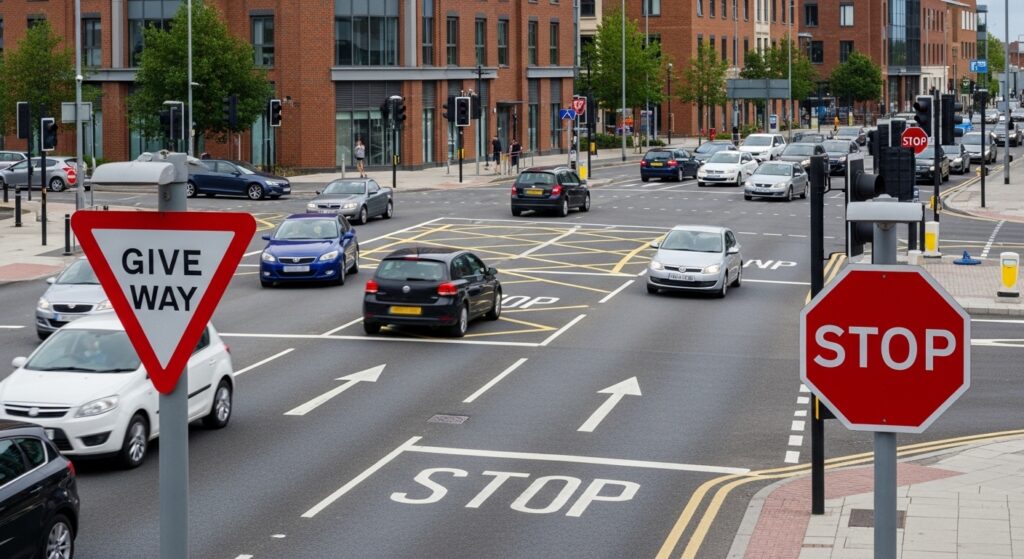
Priority signs are regulatory traffic signs that control the order in which vehicles proceed at junctions, narrow roads, crossings, and intersections. They establish right of way, helping drivers understand who must slow down, yield, or stop before continuing.
These signs remove uncertainty in traffic flow, particularly in areas where road layouts could confuse drivers. Without clear priority signage, junctions become higher-risk zones for collisions, congestion, and aggressive driving behaviour.
Priority signs work alongside road markings, signals, and traffic rules. While traffic lights actively control movement, priority signage provides constant instruction, even in low-traffic or rural areas where signals are unnecessary.
In most countries, including the UK, priority signs form part of legally enforceable traffic regulations. Drivers must obey them at all times, regardless of traffic conditions or perceived convenience.
Why Priority Signs Matter for Road Safety
Priority signs play a critical role in reducing accidents at conflict points where traffic streams intersect. Clear right-of-way rules allow drivers to anticipate movements rather than react suddenly.
Road safety studies consistently show that well-placed priority signage lowers collision rates at junctions. When drivers understand who has precedence, hesitation decreases and traffic flows more smoothly.
Priority signs also protect vulnerable road users. Pedestrians, cyclists, and motorcyclists rely on predictable vehicle behaviour, especially at crossings or narrow streets.
In residential and urban environments, priority signage helps manage traffic without excessive signals or speed enforcement. This balance keeps roads safer while maintaining efficient movement.
Common Types of Priority Signs
Give Way Signs
Give Way signs instruct drivers to slow down and yield to traffic on the main road. Drivers must allow vehicles with priority to proceed before entering the junction.
These signs usually appear at:
-
Minor road junctions
-
Roundabout entrances
-
Slip roads
In the UK, the inverted triangle shape and red border make Give Way signs instantly recognisable. Road markings often reinforce the instruction with dashed lines or painted triangles.
Stop Signs
Stop signs impose the highest level of priority control. Drivers must come to a complete stop before proceeding, even if the road appears clear.
Stop signs are used when:
-
Sightlines are restricted
-
Accident history indicates higher risk
-
Traffic volumes demand full control
Failure to stop at these signs carries serious legal consequences, including fines and penalty points.
Priority Over Oncoming Vehicles
This sign indicates that drivers have priority when passing through a narrow section of road. It commonly appears on bridges, traffic-calmed streets, or roadworks.
The sign shows a larger arrow pointing upward and a smaller arrow pointing downward, clarifying which direction has right of way. Drivers should still proceed cautiously and be prepared to stop if the path is obstructed.
Oncoming Vehicles Have Priority
This sign is the reverse of the previous one and instructs drivers to give way to traffic approaching from the opposite direction.
It appears in similar environments, particularly where road width prevents two vehicles from passing safely. The red arrow emphasises the obligation to yield.
Priority Signs in the UK Highway Code
The UK Highway Code defines priority signs as mandatory instructions backed by law. Ignoring them can result in prosecution, insurance liability, and driving licence penalties.
Priority signs fall under regulatory signage, meaning drivers must obey them regardless of road conditions. The Highway Code also explains how priority works when signs combine with road markings or traffic signals.
For example, at roundabouts, Give Way signs apply even if traffic appears light. At narrow roads, priority signs override informal courtesy rules between drivers.
The Department for Transport governs the design, placement, and usage of priority signs to ensure nationwide consistency. This standardisation helps drivers instantly recognise and respond correctly.
Where Priority Signs Are Commonly Used
Priority signs appear in locations where traffic paths intersect or narrow. Their placement depends on visibility, speed limits, and accident risk.
Common locations include:
-
Junctions between major and minor roads
-
Residential streets with traffic calming
-
Narrow bridges and tunnels
-
Temporary roadworks
-
Car parks and private access roads
In private settings, such as industrial estates or commercial car parks, priority signs still influence liability in accidents, even if public road laws do not fully apply.
Local councils often conduct traffic assessments before installing priority signage, using accident data and vehicle flow analysis to determine need.
Design Standards and Legal Requirements
Priority signs follow strict design standards to ensure immediate recognition. Shape, colour, size, and reflectivity all serve functional purposes rather than decoration.
In the UK, priority signs must comply with:
-
Traffic Signs Regulations and General Directions (TSRGD)
-
British Standards for reflectivity
-
DfT-approved materials
Signs must remain visible in low light, adverse weather, and at appropriate distances based on speed limits. Incorrect sizing or placement can reduce effectiveness and undermine enforcement.
Regular maintenance ensures signs remain legible. Faded, obscured, or damaged signs may weaken legal standing in collision disputes.
Common Driver Mistakes Related to Priority Signs
Many drivers misunderstand the difference between Give Way and Stop signs. Slowing down without stopping at a Stop sign remains a frequent cause of violations.
Another common issue involves assuming priority without checking. Even when a driver has right of way, defensive driving requires awareness of others who may fail to yield.
At narrow roads, drivers sometimes ignore priority signs out of courtesy, leading to confusion and potential accidents when both vehicles proceed simultaneously.
Misinterpreting temporary priority signs during roadworks also causes delays and near misses, especially when signage differs from permanent layouts.
How Businesses and Councils Use Priority Signs
Beyond public roads, priority signs play a role in workplace safety and traffic management. Warehouses, logistics centres, and retail parks rely on clear priority rules to prevent vehicle and pedestrian incidents.
Councils use priority signage as part of broader traffic calming strategies. Combined with speed humps, chicanes, and road narrowing, these signs help reduce vehicle speeds in residential zones.
Temporary priority signs also support event management and construction projects, allowing flexible control of vehicle flow without permanent infrastructure changes.
Frequently Asked Questions
Are priority signs legally enforceable?
Yes, on public roads priority signs carry legal authority, and failing to comply can result in penalties.
What is the difference between Give Way and Stop signs?
Give Way requires yielding when necessary, while Stop signs require a full stop regardless of traffic.
Do priority signs apply on private property?
They may not be legally enforceable, but they still influence fault and liability in accidents.
Can priority signs change over time?
Yes, councils may update signage based on traffic patterns, accident data, or road redesigns.
Who decides where priority signs are placed?
Local highways authorities or councils determine placement following traffic assessments.
Are temporary priority signs as valid as permanent ones?
Yes, temporary signs during roadworks carry the same authority when correctly installed.