Auger boring is one of the most widely used trenchless construction techniques for installing underground utilities beneath roads, railways, and other surface obstacles. Known for its accuracy, strength, and cost-effectiveness, auger boring has been a trusted method in the construction industry for decades. Contractors continue to rely on this technique for projects that require precision and minimal surface disruption.
With the support of reliable equipment, wear parts, and accessories from suppliers such as Wolf Machinery Supply, Auger Boring operations can be performed efficiently, safely, and with long-term reliability. This article provides a comprehensive overview of auger boring, how it works, its advantages, applications, and why proper equipment and components are essential for success.
What Is Auger Boring?
Auger boring is a trenchless drilling method used to install steel casing pipes horizontally through soil. The process involves rotating an auger inside a steel casing to excavate soil while simultaneously pushing the casing forward through the ground.
Unlike some advanced trenchless methods, auger boring is a mechanically straightforward system, making it ideal for short to medium-length bores that require a straight and controlled installation path.
This method is commonly used for:
Road crossings
Railway crossings
Utility installations
Drainage and sewer lines
Industrial and municipal projects
How the Auger Boring Process Works
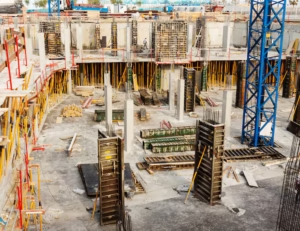
The auger boring process begins with the preparation of a launch pit and a receiving pit. The equipment is set up in the launch pit and aligned precisely with the desired bore path.
Step-by-Step Auger Boring Process
Setup and Alignment
The auger boring machine is positioned and aligned carefully to ensure a straight bore. Accurate alignment is critical, as auger boring does not allow for steering once drilling begins.
Casing Installation
A steel casing pipe is placed against the cutting head. This casing supports the borehole as drilling progresses.
Soil Excavation
The rotating auger inside the casing removes soil and transports it back to the launch pit.
Forward Thrust
Hydraulic thrust from the auger boring machine pushes the casing pipe forward as excavation continues.
Casing Advancement
Additional casing sections are added until the bore reaches the receiving pit.
Utility Installation
Once the casing is installed, the utility pipe is placed inside the casing.
Key Components of an Auger Boring System
Successful auger boring operations depend on high-quality equipment and components. Each part plays a critical role in performance and accuracy.
Auger Boring Machine
The machine provides rotational torque and thrust. It must be powerful enough to handle soil resistance while maintaining alignment.
Augers
Augers are responsible for removing excavated material. Durable augers reduce downtime and improve drilling efficiency.
Cutting Heads
Cutting heads vary based on soil conditions. Selecting the right cutting head ensures smoother excavation and longer tool life.
Steel Casing
The casing pipe supports the borehole and prevents collapse. Proper casing selection is essential for structural integrity.
Wear Parts and Components
Wear parts such as teeth, bits, and bearings experience constant abrasion. Replacing these components with high-quality parts—like those supplied by Wolf Machinery Supply—helps maintain productivity and prevent costly failures.
Advantages of Auger Boring
Auger boring remains popular due to its reliability and efficiency in many underground applications.
1. Minimal Surface Disruption
Because auger boring is trenchless, it avoids cutting through roads, railways, and landscaped areas, reducing restoration costs.
2. High Accuracy
When properly aligned, auger boring provides straight and precise installations, making it ideal for utility crossings.
3. Cost-Effective
Compared to more advanced trenchless methods, auger boring equipment is relatively simple, reducing operational and maintenance costs.
4. Strong Ground Support
The steel casing provides immediate support, minimizing the risk of bore collapse in suitable soil conditions.
5. Proven Technology
Auger boring has been used successfully for decades, making it a trusted solution for contractors and municipalities.
Soil Conditions Suitable for Auger Boring
Auger boring performs best in stable soils, including:
Clay
Silty clay
Loam
Firm sand
It is less effective in:
Loose, running sands
Gravel with large cobbles
Highly fractured rock
Proper soil evaluation is critical before selecting auger boring as the preferred method.
Applications of Auger Boring
Auger boring is widely used across multiple industries due to its versatility.
Utility Installations
Water lines, sewer pipes, gas lines, and electrical conduits are commonly installed using auger boring.
Road and Highway Crossings
Auger boring allows utilities to pass beneath roads without disrupting traffic flow.
Railroad Crossings
Rail authorities often prefer auger boring due to its controlled and stable excavation process.
Industrial Projects
Factories, plants, and warehouses rely on auger boring for underground service installations.
Auger Boring vs. Horizontal Directional Drilling (HDD)
While both are trenchless methods, auger boring and HDD serve different purposes.
Auger Boring
Straight-line bores only
Best for short to medium distances
Requires launch and receiving pits
Uses steel casing
Horizontal Directional Drilling
Steerable and curved bores
Suitable for longer distances
Requires drilling fluids
Can install various pipe materials
Contractors choose auger boring when accuracy, simplicity, and casing support are priorities.
Importance of Quality Equipment and Wear Parts
Auger boring involves constant mechanical stress, abrasion, and torque. Using low-quality components can lead to frequent breakdowns, misalignment, and increased project costs.
Reliable suppliers like Wolf Machinery Supply support contractors by offering:
Durable wear parts
Heavy-duty components
Equipment suited for underground construction
Expert product knowledge
Quality parts reduce downtime, improve safety, and extend the life of auger boring systems.
Maintenance and Best Practices
Proper maintenance ensures consistent auger boring performance.
Regular Inspections
Check augers, cutting heads, and bearings for wear before each job.
Alignment Checks
Even minor misalignment can result in costly corrections or failed bores.
Timely Replacement of Wear Parts
Replacing worn components early prevents damage to larger system elements.
Operator Training
Experienced operators improve efficiency and reduce the risk of errors.
Safety Considerations
Safety is critical in auger boring operations. Key considerations include:
Proper shoring of pits
Secure equipment setup
Monitoring ground conditions
Following OSHA and local safety standards
Using reliable equipment and components reduces the risk of accidents and mechanical failures.
Conclusion
Auger boring remains a dependable and efficient trenchless construction method for installing underground utilities. Its simplicity, accuracy, and cost-effectiveness make it a preferred choice for many contractors and municipalities.
When combined with high-quality equipment, durable wear parts, and expert support from trusted suppliers like Wolf Machinery Supply, auger boring projects can be completed safely, efficiently, and on schedule. Understanding the process, selecting the right components, and following best practices ensures long-term success in underground construction.