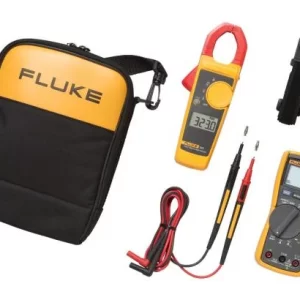
Electrical experts have to depend on precision measurement tools every day, and having the appropriate tool will influence both their safety and efficiency. In this case, the digital multimeter is what most electrical experts use when measuring current, voltage, and resistance. There are different models that vary significantly in terms of safety ratings, accuracy, and display performance.
This guide covers safety category ratings, True RMS capability, resolution, accuracy and build quality. Each one helps electricians match a meter to residential, commercial or industrial work.
Which Safety Rating Should an Electrician Look For?
Select either a CAT III or CAT IV rating for mains circuits depending on the voltage rating of the circuit. The IEC 61010 standard uses categories based on the amount of transient energy supplied by the installation. The most common categories electricians encounter include:
- CAT II: single-phase outlet-connected loads
- CAT III: three-phase distribution and single-phase commercial lighting
- CAT IV: three-phase power supply and outdoor wiring
The voltage is as important as the category rating. The higher CAT III 1000V meter provides better protection compared to CAT III 600 V. On the other hand, a CAT II 1000 V meter is inferior to a CAT III 600V meter. All digital multimeters should have the seal from at least one testing organization.
Does an Electrician Need a True RMS Meter?
Yes, whenever loads are distorted. True RMS meters measure both clean and distorted waveforms accurately. Average-responding meters are designed around sine waves, so they match standard AC circuits well. Electronic loads change the waveform shape, and True RMS readings reflect that shape directly.
Variable frequency drives and computerized HVAC controls are common examples. For outlets, fixtures, and basic wiring, either meter type gives dependable results. A digital multimeter with True RMS suits electricians who service drives and electronic equipment.
What Counts and Accuracy Are Acceptable?
A count of 4000 to 6000 with an accuracy of 0.5% DC voltage is sufficient for most professional uses. In datasheets, the accuracy is expressed as a percentage, while the accuracy of other calculations must be near the basic DC voltage accuracy. The following table shows the requirements you need to consider:
| Specification | Benchmark | Practical Value |
| Resolution | 6000 counts on a 600 V range | Displays readings in 0.1 V steps |
| Input impedance | 10 megaohms | Reduces loading on the circuit under test |
| Accuracy consistency | Other functions close to the DC volts accuracy figure | Provides consistent readings across measurement tasks |
| Auto-ranging | Included, with manual override | Allows faster and simpler readings |
Final Thoughts
Four things should be taken into consideration when opting for a digital multimeter. These include the correct CAT rating, True RMS for non-linear loads, suitable counts and accuracies, and a tough construction.
The electrician who considers these criteria before buying the multimeter gets accurate readings and ensures safer testing. This simple task ensures safety for the user and the installation. For a reliable digital multimeter, you can reach out to Presidium PH. They are an authorized distributor of Fluke and have a wide range of electrical testing devices.