Compressed air is a valuable utility in workshops and automated production, but losses often go unnoticed. A faint hiss may continue across every shift. A Pneumatic Fittings Maintenance Kit can support a more organised response by making common connection components available when maintenance teams need them.
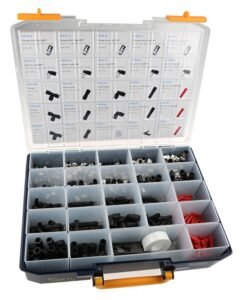
The Pneumatic Fittings Maintenance Kit, Legris 3151 00 01 58BP, brings together LF3000 push-in components for common 4, 6 and 8 mm tubing. Engineers can use the assortment in a planned stock and inspection process. The kit supports repairs, but it cannot substitute for correct diagnosis or safe isolation.
Why Does Compressed-Air Waste Deserve Attention?
A leaking joint may allow equipment to keep running, which makes the problem easy to postpone. Nevertheless, escaping air forces the system to supply flow that produces no useful work. That can increase energy consumption and place additional demand on compressors as leaks accumulate.
Poor connections can also undermine process consistency. Pressure losses near a pneumatic actuator may contribute to slower or irregular movement, although other faults can cause similar symptoms. Measuring the system before changing parts helps identify the real cause.
Look Beyond the Audible Hiss
Not every leak is easy to hear in a noisy factory. Maintenance teams can inspect connections using an approved leak-detection method and record where leakage occurs, how severe it appears and whether it changes during machine operation.
A useful inspection record distinguishes the observed symptom from the suspected cause. For example, “air escaping beside a 6 mm tube connection” is more informative than “bad fitting” because it provides a useful starting point.
How Can Standardised Spares Make Maintenance Easier?
A well-organised maintenance store reduces the need to search multiple drawers for an unfamiliar connector. Standardisation is particularly valuable when equipment uses several tube sizes but the same general fitting family. Identify components by function and dimensions rather than appearance alone.
The Legris assortment includes straight connectors, equal elbows, equal tees, reducers and blanking plugs, plus threaded fitting options. A tube cutter and PTFE tape are also listed. Distributor information describes the LF3000 kit range as containing more than 300 parts, making stock control worthwhile.
Give Each Component a Clear Purpose
The shapes are not interchangeable simply because they accept similar tubing:
- Straight connectors continue a tube run without adding a branch.
- Elbows change routing direction where the installation permits.
- Tees create an additional connection in a planned air circuit.
- Reducers accommodate specified transitions between compatible tube sizes.
- Blanking plugs close suitable unused openings during a controlled modification.
Before fitting any replacement, verify thread form, tubing material, outside diameter and pressure limits against the actual part documentation. Similar-looking threaded studs may use different sealing arrangements.
What Does a Preventive Maintenance Programme Look Like?
Instead of waiting for a production stop, teams can inspect frequently disturbed connections during scheduled machine checks. Areas near moving assemblies, maintenance access panels and regularly disconnected lines deserve attention because conditions can change.
The objective is to identify emerging problems before they affect output, not to replace every fitting on a calendar date.
Build a Repeatable Inspection Routine
- Identify the machine and its normal operating conditions.
- Observe pressure behaviour and note unusual compressor activity.
- Check accessible tubing for wear, poor support or tight bends.
- Locate suspected leaks using an approved technique.
- Record the fitting size and exact location before selecting parts.
- Schedule corrective work with authorised personnel and suitable isolation.
Any intervention must begin by isolating the air supply, preventing unintended movement and safely releasing stored pressure. A stationary machine can still contain hazardous pneumatic energy.
Why Do Routing and Installation Details Matter?
A new fitting may stop a leak without removing the reason the joint failed. Repeated tube movement, accidental pulling or an unsupported bend can transfer stress into a push-in connection. Better routing may prevent recurring damage.
Keep tube ends clean and square, follow the insertion-depth guidance and avoid side loading. Where threads require sealing, use only the approved method for that thread type. PTFE tape should never be treated as a universal solution for every pneumatic connection.
Design for the Next Technician
Accessible fittings are easier to identify, inspect and replace. Clearly labelled air lines and an up-to-date schematic can prevent unnecessary disconnections during troubleshooting.
Record whether unused ports were deliberately blanked or temporarily isolated, reducing future confusion.
How Can Teams Demonstrate Maintenance Improvement?
Maintenance performance becomes more persuasive when observations are measured. Record the number of confirmed leaks found during inspections, the types of failures and the time spent completing corrective tasks.
Compare similar operating periods and account for demand changes. A lower leak count may suggest improvement, but it should be supported by reliable measurements rather than assumptions about energy savings.
Keep the Kit Ready Without Overordering
Check which sizes the site uses most often, then replenish the corresponding components before stocks become critically low. Separate unopened inventory from returned or unverified fittings, and protect clean parts from dirt entering their sealing surfaces.
This keeps inventory dependable and helps teams plan replenishment.
Final Thoughts
The value of a Pneumatic Fittings Maintenance Kit extends beyond an emergency repair. Used within a disciplined maintenance programme, the Legris 3151 00 01 58BP assortment can support faster component identification, sensible stock control and more consistent attention to compressed-air losses.
The strongest results still depend on safe working procedures, correct part matching and verified repairs. When teams combine those habits with reliable records and thoughtful tube routing, small connections become part of a more efficient and maintainable pneumatic system.