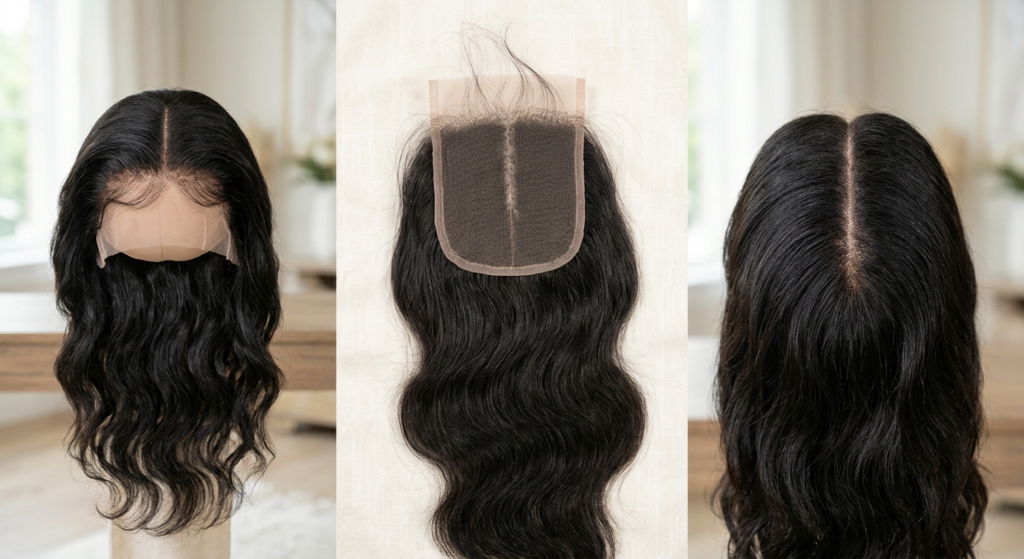
When designing or choosing a custom wig, the crown and parting area determine how realistic the final unit looks. Utilizing high-definition lace pieces offers a sheer, skin-like base, but the amount of hair attached to that base dictates your overall styling flexibility. Choosing the right density for your Hd lace closures ensures that your parting lies flat, your unit moves naturally, and your hairline remains completely undetectable.
Understanding how strand concentration affects weight distribution and parting depth helps you construct wigs tailored to your personal aesthetic. Here is how hair density across Hd lace closures directly impacts your daily wig styling options.
1. Defining Parting Clarity and Flatness
The primary job of a closure is to provide a clean, realistic parting space that mimics natural scalp growth.
- Avoiding the Bulky Crown: Excessive density near the center or side part forces the hair to stand upward, creating an artificial bump along the top of your wig.
- Achieving a Flat Lay: Lightweight to medium-density Hd lace closures allow the hair strands to fall naturally against your head, creating a flat, sleek profile that requires minimal heat pressing.
- Scalp Visibility: A balanced density profile ensures that your parted line displays an appropriate amount of visible lace scalp without showing wide gaps or bare patches.
2. Managing Weight Distribution for Swept and Layered Styles
How your wig holds thermal styling or face-framing cuts depends on how much hair mass sits over the top of your head.
- Curtain Bangs and Face-Framing Layers: Medium-density pieces provide enough hair volume to cut soft curtain bangs or side-swept fringes without making the front of your wig feel front-heavy.
- Half-Up, Half-Down Styling: Sweeping the top section of your wig into a half-up ponytail or top knot requires adequate density across Hd lace closures so that underlying tracks remain completely hidden when hair is pulled back.
3. Plucking and Perimeter Customization Demands
The density of your piece directly dictates how much preparation work is needed prior to installation.
- Pre-Plucked Graduated Edges: High-density closures require careful manual plucking along the front edge to thin out stiff, uniform hairlines into a soft gradient.
- Protecting the Fragile Lace Base: Because high-definition lace uses ultra-thin, delicate mesh fibers, working with lower initial density reduces the amount of tweezing required, preserving the structural integrity of your Hd lace closures over long-term use.
4. Matching Closure Density to Bundle Count
A common mistake when constructing custom wigs is pairing a sparse closure with heavy, dense bundles, or vice versa.
- Creating a Seamless Transition: If your wig cap utilizes three or four heavy bundles, choosing a higher-density closure prevents a noticeable drop in volume near the crown.
- Natural Everyday Installations: For two-bundle units or shorter bob cuts, opting for a lower-density piece ensures the top layers blend fluidly into the rest of the unit without creating top-heavy proportions.
5. Longevity and Maintenance Considerations
The concentration of hand-tied knots across your lace grid affects how the unit wears over time.
- Shedding Prevention: Denser pieces offer more leeway over months of wear, as natural shedding from brushing and styling will not immediately leave sparse patches.
- Gentle Detangling Routines: Regardless of density, always detangle your closure from the tips upward using a wide-tooth comb to avoid pulling knots through the ultra-thin HD lace grid.
Conclusion
Finding the ideal balance of hair density is essential for achieving a natural, salon-grade wig transformation. By selecting Hd lace closures with a density profile suited to your desired hairstyle, you ensure a flat, realistic parting space, effortless layering, and an undetectable finish every time.